Have you ever wished your software could do more than simply respond to commands? What if it could understand a goal, make decisions, take actions, and complete tasks on your behalf?
This is exactly where AI agents come into the picture.
Artificial Intelligence (AI) has evolved rapidly over the last few years. We started with chatbots that could answer questions, but today’s AI systems can perform complex tasks, automate workflows, analyze data, and even collaborate with humans. These advanced systems are known as AI agents.
From healthcare and business operations to software development and customer support, AI agents are becoming one of the most important technology trends worldwide. Organizations across India are also exploring AI-powered automation to improve productivity, reduce costs, and deliver better services.
In this complete beginner’s guide, you’ll learn:
- What AI agents are
- How AI agents work
- Different types of AI agents
- Benefits and real-world applications
- Popular AI agent tools
- Challenges and limitations
- Future trends and opportunities
Whether you’re a doctor, healthcare professional, developer, student, or tech enthusiast, this guide will help you understand the growing world of AI agents.
Why AI Agents Matter in 2026
Artificial intelligence is no longer limited to generating text or answering questions.
According to reports from industry leaders such as Google, Microsoft, OpenAI, Gartner, and McKinsey, businesses are increasingly investing in AI-powered automation and autonomous systems. AI agents represent the next stage of AI evolution because they can move beyond conversation and actually complete tasks.
The Shift from Chatbots to AI Agents
Traditional AI chatbots:
- Answer questions
- Generate content
- Summarize information
AI agents:
- Understand goals
- Create action plans
- Use tools and software
- Make decisions
- Execute tasks automatically
- Learn from feedback
Think of a chatbot as a knowledgeable assistant who provides information.
Think of an AI agent as a digital employee that can help get work done.
What Are AI Agents?
An AI agent is an intelligent software system that can perceive information, make decisions, and take actions to achieve a specific goal with minimal human intervention.
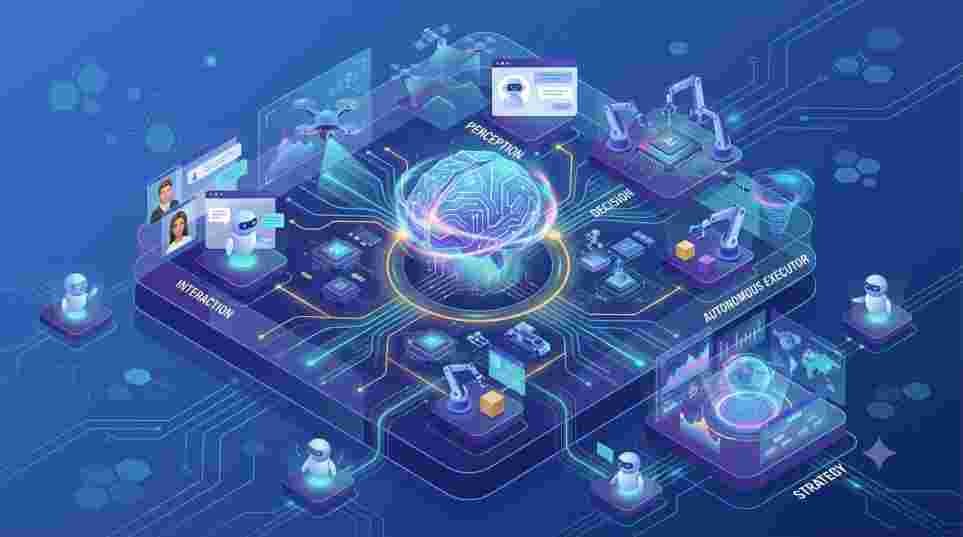
Instead of waiting for step-by-step instructions, AI agents can:
- Analyze situations
- Plan tasks
- Choose actions
- Use external tools
- Adapt based on outcomes
Simple Definition
An AI agent is like a virtual assistant that doesn’t just answer questions—it performs actions to accomplish objectives.
Example
If you ask a chatbot:
“Find the best hospitals in Ahmedabad.”
It will provide information.
If you ask an AI agent:
“Research the best hospitals in Ahmedabad, compare services, create a report, and email me the results.”
The agent can perform the entire workflow.
How AI Agents Work
AI agents generally follow a cycle of observation, reasoning, action, and learning.
Step 1: Perceive Information
The agent collects information from:
- User inputs
- Databases
- Websites
- Sensors
- Documents
- APIs
Example
A healthcare AI agent may collect:
- Patient records
- Lab reports
- Medical history
- Appointment schedules
Step 2: Understand the Goal
The agent identifies the user’s objective.
For example:
“Schedule follow-up appointments for all diabetic patients this week.”
The agent understands the task and desired outcome.
Step 3: Create a Plan
The AI agent breaks the goal into smaller tasks.
Example:
- Identify diabetic patients.
- Check availability.
- Schedule appointments.
- Send reminders.
Step 4: Take Action
The agent interacts with tools and systems.
Examples include:
- Sending emails
- Updating databases
- Generating reports
- Booking appointments
- Performing calculations
Step 5: Learn and Improve
Advanced AI agents analyze results and improve future performance.
This feedback loop makes them more effective over time.
Types of AI Agents
Not all AI agents work the same way.
1. Simple Reflex Agents
These agents react based on predefined rules.
Example
A spam filter detecting unwanted emails.
Pros
- Fast
- Simple
Cons
- No learning capability
2. Model-Based Agents
These agents maintain an internal understanding of the environment.
Example
Navigation systems predicting traffic conditions.
3. Goal-Based Agents
These agents focus on achieving a specific objective.
Example
An AI scheduling assistant organizing meetings.
4. Utility-Based Agents
These agents choose actions that maximize benefits.
Example
Investment recommendation systems.
5. Learning Agents
These agents improve through experience.
Example
Modern AI copilots and autonomous assistants.
Benefits of AI Agents
AI agents are transforming industries because they offer significant advantages.
1. Increased Productivity
AI agents automate repetitive work, allowing professionals to focus on high-value activities.
Healthcare Example
Doctors can spend more time with patients instead of handling administrative tasks.
2. Faster Decision-Making
AI agents analyze large amounts of data quickly.
Benefits include:
- Faster reporting
- Better recommendations
- Improved diagnostics
3. 24/7 Availability
Unlike human workers, AI agents can operate continuously.
This is particularly valuable for:
- Customer support
- Healthcare monitoring
- IT operations
4. Cost Savings
Automation reduces operational expenses and improves efficiency.
5. Better Accuracy
AI agents can minimize human errors when properly configured.
AI Agents in Healthcare
Healthcare is one of the most promising areas for AI agents.
Use Cases
Patient Scheduling
AI agents can:
- Manage appointments
- Send reminders
- Reduce no-shows
Medical Documentation
Agents can summarize consultations and generate notes.
Clinical Decision Support
They help doctors analyze:
- Lab reports
- Medical images
- Patient histories
Remote Monitoring
AI agents monitor health data from wearable devices and alert healthcare teams when necessary.
Popular AI Agent Tools and Platforms
Several companies are developing AI agent technologies.
| Tool | Best For | Pros | Cons |
|---|---|---|---|
| ChatGPT Agents | Research & automation | Easy to use | Requires oversight |
| Microsoft Copilot | Business productivity | Deep Microsoft integration | Enterprise-focused |
| Google Gemini | Productivity & research | Strong ecosystem | Features vary by region |
| Claude | Writing & analysis | Long-context understanding | Tool access limitations |
| AutoGPT | Autonomous workflows | Open-source flexibility | Technical setup required |
| CrewAI | Multi-agent systems | Developer friendly | Requires coding knowledge |
Which Tool Should Beginners Choose?
For beginners:
- ChatGPT Agents
- Google Gemini
- Microsoft Copilot
For developers:
- CrewAI
- AutoGPT
- LangGraph-based agents
Practical Guide: How to Start Using AI Agents
You don’t need advanced programming knowledge to begin.
Step 1: Identify a Repetitive Task
Examples:
- Research
- Email management
- Report creation
- Appointment scheduling
Step 2: Choose an AI Platform
Start with:
- ChatGPT
- Gemini
- Claude
- Microsoft Copilot
Step 3: Define a Clear Goal
Bad instruction:
Help me with work.
Better instruction:
Research AI healthcare trends and create a 500-word summary.
Step 4: Test Small Workflows
Begin with simple automations.
Examples:
- Summarizing documents
- Creating reports
- Organizing information
Step 5: Monitor Results
Always review outputs before taking important actions.
Human oversight remains essential.
Challenges and Limitations of AI Agents
While AI agents are powerful, they are not perfect.
Challenge 1: Hallucinations
AI may generate incorrect information.
Solution
Verify outputs using trusted sources.
Challenge 2: Privacy Concerns
Sensitive data may be exposed if security controls are weak.
Solution
Use secure platforms and comply with data protection regulations.
Challenge 3: Limited Context
Some agents may misunderstand complex situations.
Solution
Provide detailed instructions and context.
Challenge 4: High Implementation Costs
Advanced enterprise solutions can be expensive.
Solution
Start with small pilot projects before scaling.
Challenge 5: Regulatory and Ethical Issues
Industries such as healthcare require careful oversight.
Solution
Keep humans involved in critical decisions.
Future of AI Agents: What to Expect
The future of AI agents looks incredibly promising.
Over the next few years, we will likely see:
- Multi-agent collaboration
- AI-powered digital coworkers
- Smarter healthcare assistants
- Autonomous business operations
- Personalized education systems
- Advanced software development agents
Conclusion
AI agents represent the next major evolution in artificial intelligence. Unlike traditional chatbots, they can understand goals, plan actions, interact with tools, and complete tasks with minimal supervision.
As AI technology continues to advance, AI agents will become increasingly common in healthcare, software development, education, business operations, and everyday life.
The best time to start learning about AI agents is now. Begin with simple tools, experiment with real-world workflows, and gradually explore more advanced automation possibilities.
Have questions about AI agents or AI automation? Share your thoughts in the comments, discuss your experiences with the community, or contact us at contact@vitalstack.co.in.
Frequently Asked Questions (FAQ)
1. What is an AI agent in simple terms?
An AI agent is software that can understand goals, make decisions, and perform tasks automatically instead of simply answering questions.
2. How are AI agents different from chatbots?
Chatbots primarily provide information, while AI agents can take actions, use tools, and complete workflows.
3. Can AI agents be used in healthcare?
Yes. AI agents can help with appointment scheduling, documentation, patient monitoring, clinical support, and administrative automation.
4. Do I need coding skills to use AI agents?
No. Many modern AI platforms allow beginners to use AI agents without programming knowledge.
5. Are AI agents safe?
They can be safe when used responsibly with proper security measures, human oversight, and data privacy protections.
6. What is the best AI agent tool for beginners?
ChatGPT, Google Gemini, and Microsoft Copilot are among the easiest AI agent platforms for beginners.
Published on VitalStack.co.in | Author: Elena Brooks | Contact: contact@vitalstack.co.in
Enjoyed this article?
Subscribe for weekly deep-dives on AI and health — straight to your inbox.