
Introduction
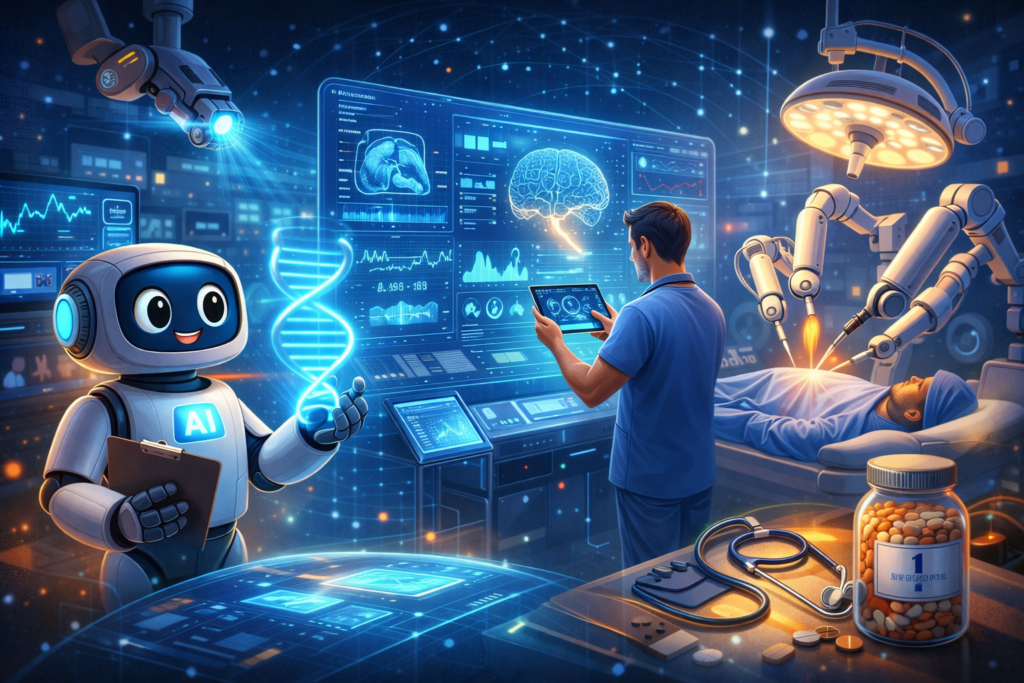
Artificial Intelligence (AI) is no longer just a concept in science fiction. In 2026, AI is actively transforming the global healthcare industry. From faster disease detection to robotic surgeries and personalized medicine, AI is helping doctors make smarter and quicker decisions.
But how exactly is AI changing healthcare? Is it safe? And what does the future look like?
In this complete guide, VitalStack explores how AI is reshaping modern medicine and what it means for patients, hospitals, and healthcare professionals.
Table of Contents
Why AI in Healthcare Is Growing Rapidly in 2026
The global AI healthcare market is projected to grow significantly between 2026 and 2035.
According to the World Health Organization (WHO), global healthcare systems are under increasing pressure due to aging populations, chronic diseases, and workforce shortages. AI technologies are being explored to improve efficiency and patient outcomes worldwide.
Key growth drivers include:
- Rising healthcare costs
- Shortage of medical professionals
- Increasing patient data
- Demand for personalized medicine
- Advancements in machine learning
Hospitals are adopting AI to improve efficiency, reduce costs, and enhance patient outcomes.
What Is AI in Healthcare?
AI in healthcare refers to the use of machine learning algorithms, predictive analytics, and smart automation tools to improve medical services.
Instead of replacing doctors, AI acts as a powerful assistant that:
- Analyzes medical data
- Detects patterns in patient records
- Supports diagnosis
- Recommends treatments
- Predicts disease risks
The goal is simple: improve patient outcomes while reducing costs and human error.
How AI Is Transforming Healthcare in 2026
1. Early Disease Detection
AI systems can analyze X-rays, MRIs, and CT scans faster than traditional methods.
For example, AI tools can detect:
- Early-stage cancer
- Heart abnormalities
- Lung infections
- Brain tumors
Early detection saves lives and reduces treatment costs.
Research supported by the National Institutes of Health (NIH) highlights how artificial intelligence models are improving medical imaging accuracy and reducing diagnostic errors in early-stage disease detection.
2. Personalized Medicine
AI can analyze genetic data and medical history to create personalized treatment plans.
Instead of “one-size-fits-all” medicine, patients now receive targeted treatments based on:
- DNA profile
- Lifestyle
- Medical history
This increases success rates significantly.
3. AI-Powered Virtual Health Assistants
Chatbots and virtual health assistants help patients:
- Book appointments
- Get medication reminders
- Ask basic health questions
This reduces hospital workload and improves patient convenience.
4. Robotic Surgery
AI-assisted robotic systems help surgeons perform complex procedures with greater precision.
Benefits include:
- Smaller incisions
- Faster recovery
- Reduced human error
- Lower complication rates
5. Drug Discovery Acceleration
Developing a new drug traditionally takes 10+ years.
AI can analyze millions of chemical combinations in weeks, dramatically reducing development time.
This is especially important during global health crises.
Real-World Examples of AI in Healthcare
Artificial Intelligence is already being used by some of the world’s leading healthcare organizations.
For example:
- IBM Watson Health has helped doctors analyze cancer treatment options using AI-driven data insights.
- Google DeepMind developed AI systems that can detect over 50 eye diseases from retinal scans.
- Pfizer uses AI to accelerate drug discovery and vaccine development.
- Mayo Clinic integrates AI tools to assist in diagnostics and patient monitoring.
These real-world implementations prove that AI in healthcare is not experimental — it is actively transforming modern medicine.
Benefits of AI in Healthcare
✔ Faster diagnosis
✔ Reduced medical errors
✔ Lower healthcare costs
✔ Better patient experience
✔ Improved hospital efficiency
AI in Healthcare vs Traditional Medical Systems
Traditional healthcare systems rely heavily on manual analysis, paper-based records, and time-consuming diagnostics.
AI-powered healthcare systems offer:
| Traditional Healthcare | AI-Powered Healthcare |
|---|---|
| Manual diagnosis | AI-assisted diagnosis |
| Reactive treatment | Predictive healthcare |
| Higher error rates | Data-driven accuracy |
| Longer wait times | Faster decision-making |
AI does not replace doctors — it enhances medical decision-making using predictive analytics and machine learning models.
Challenges and Risks
While AI has huge potential, there are concerns:
- Data privacy risks
- Algorithm bias
- Regulatory challenges
- Dependence on technology
Healthcare data must be handled responsibly and securely.
The Future of AI in Healthcare (2026–2035)
Experts predict massive growth in:
- AI-driven remote monitoring
- Smart wearable health devices
- Predictive health analytics
- Fully automated diagnostic systems
AI will not replace doctors — it will empower them.
The future of medicine is collaborative: humans + intelligent machines.
Top AI Healthcare Companies in 2026
Several technology companies are leading the AI healthcare revolution:
- NVIDIA healthcare AI solutions– AI-powered medical imaging solutions
- Microsoft Cloud for Healthcare – Cloud-based healthcare AI platforms
- Siemens Healthineers AI solutions – AI diagnostics and imaging systems
- Johnson & Johnson medical AI – AI-driven robotic surgery innovation
These companies are investing billions in AI research and medical technology.
Frequently Asked Questions (FAQ)
Is AI replacing doctors?
No. AI assists doctors by providing data insights. Final decisions remain with medical professionals.
Is AI in healthcare safe?
When properly regulated and tested, AI systems are designed to improve safety and accuracy.
Can AI detect diseases better than humans?
In some cases, AI can detect patterns faster and more accurately, especially in medical imaging.
How AI Reduces Healthcare Costs
One of the biggest advantages of AI in healthcare is cost reduction.
AI helps hospitals:
- Automate administrative tasks
- Reduce misdiagnosis
- Prevent unnecessary hospital admissions
- Optimize treatment plans
- Improve operational efficiency
According to industry reports, AI-driven automation could save billions in healthcare spending annually.
Final Thoughts
Artificial Intelligence is revolutionizing healthcare in 2026. From early disease detection to robotic surgery and personalized treatment, AI is making medicine smarter, faster, and more accessible.
For patients, this means better care.
For doctors, this means better tools.
For the world, this means a healthier future.
As AI technology continues to evolve, healthcare will never be the same again.
🔎 Continue Exploring Artificial Intelligence on VitalStack
👉 How to Invest in Artificial Intelligence in 2026 (Beginner’s Guide to AI Stocks, ETFs & Startups)
👉 Best AI SaaS Business Ideas to Start in 2026
👉 What Is Technology? Simple Explanation for Beginners (2026 Guide)