
Introduction
When building a modern application in 2026, one of the most important technical decisions you will face is choosing the right backend architecture.
Should you build everything as a single system, or should you divide it into multiple independent services?
The debate between microservices vs monolith in 2026 is not just a technical discussion anymore. It affects scalability, performance, infrastructure cost, hiring strategy, and even long-term business growth.
If you’re a startup founder, backend developer, SaaS builder, or someone preparing for system design interviews, understanding this backend architecture comparison is essential.
In this guide, we’ll break everything down in simple, practical terms so you can confidently choose the right scalable application architecture for your project.
What Is Monolithic Architecture?
A monolithic architecture is a traditional way of building applications where the entire system is developed and deployed as a single unit.
That means:
- All backend logic lives together
- Authentication, APIs, database access, and business logic are tightly connected
- Everything runs as one application
If you update one part of the system, you redeploy the entire application.
For small teams and early-stage projects, this approach feels simple and manageable.
Why Many Startups Still Choose Monoliths in 2026
Even in 2026, monolithic architecture remains popular — especially for MVPs.
Here’s why.
1. Faster Development
When you’re building your first version of a product, speed matters more than perfection. A monolith allows developers to move quickly without worrying about distributed systems or complex infrastructure.
2. Lower Initial Cost
You don’t need advanced DevOps pipelines, multiple servers, or container orchestration tools. Hosting is simpler and more affordable in the beginning.
3. Easier Debugging
When something breaks, you look in one place. There are no inter-service communication failures to investigate.
For early-stage startups, this simplicity is extremely valuable.
Where Monolithic Architecture Struggles
However, as your application grows, cracks begin to appear.
- Scaling requires scaling the entire system
- Large codebases become difficult to manage
- Deployments become riskier
- Team collaboration slows down
If your product starts gaining heavy traffic, performance optimization becomes harder.
This is where microservices enter the picture.
What Is Microservices Architecture?
Microservices architecture breaks an application into smaller, independent services.
Each service handles a specific responsibility.
For example:
- User service
- Payment service
- Product service
- Notification service
Each service can be developed, deployed, and scaled independently.
Instead of one large system, you now have multiple small systems communicating via APIs.
This is why microservices are often considered a modern scalable application architecture.
Why Microservices Are Popular in 2026
In 2026, most high-growth SaaS companies prefer microservices.
Here’s why.
1. Independent Scalability
If your payment system experiences heavy traffic, you scale only that service — not the entire application.
This makes infrastructure more efficient under high load.
2. Better Fault Isolation
If one service crashes, the entire system doesn’t necessarily go down.
This improves reliability and uptime.
3. Flexible Technology Choices
Different services can use different programming languages or databases if required.
This flexibility supports innovation and rapid scaling.
The Hidden Complexity of Microservices
While microservices offer strong scalability benefits, they are not simple.
They require:
- API gateways
- Service discovery
- Monitoring tools
- Logging systems
- CI/CD pipelines
- Container orchestration (often Kubernetes)
Without proper DevOps knowledge, microservices can quickly become overwhelming.
That’s why not every project needs them.
Microservices vs Monolith in 2026: Direct Comparison
Let’s simplify the backend architecture comparison.
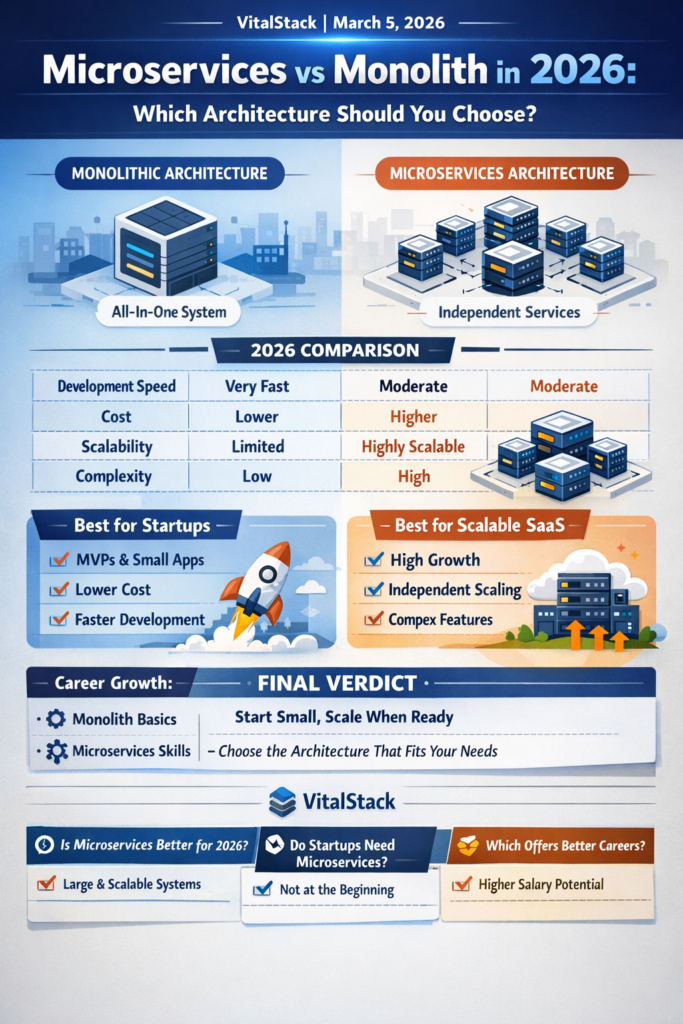
| Factor | Monolith | Microservices |
|---|---|---|
| Initial Development Speed | Very Fast | Moderate |
| Infrastructure Cost | Lower | Higher |
| Scalability | Limited | Highly Scalable |
| Deployment | Single Unit | Independent Services |
| Complexity | Low | High |
| Best For | MVPs, Small Apps | SaaS, Enterprise Systems |
Both architectures have strengths. The real question is timing and scale.
Which Architecture Is Best for Startups in 2026?
If you are building:
- A new SaaS product
- A startup MVP
- A small internal tool
A well-structured monolith is usually the smarter choice.
Over-engineering early is one of the biggest mistakes new founders make.
Build simple. Validate your idea. Scale later.
Which Architecture Is Best for Scalable SaaS Platforms?
If you expect:
- Rapid user growth
- High traffic
- Multiple development teams
- Complex feature expansion
Microservices architecture becomes more practical.
Large SaaS platforms rely on microservices because scalability and independent deployment are critical for long-term growth.
Performance: Microservices vs Monolith
Performance depends more on implementation than architecture.
Monolith advantage:
- Faster internal communication (no network calls between services)
Microservices advantage:
- Better load distribution
- Independent scaling under heavy traffic
In high-scale environments, microservices often provide better performance stability.
Backend Architecture Trends in 2026
Modern backend systems are moving toward:
- Cloud-native development
- Containerization
- Serverless computing
- API-first design
- Distributed systems
Microservices align naturally with these trends.
However, many companies now use a “modular monolith” approach — keeping simplicity while preparing for future scalability.
This balanced approach is becoming increasingly popular in 2026.
Career Growth: What Should Developers Learn?
If you’re thinking about your backend development career, here’s the honest answer:
Learn both.
Understanding monolithic architecture teaches you strong fundamentals.
Understanding microservices teaches you:
- Distributed systems
- API communication
- System design
- Scalability patterns
Developers with microservices experience often earn higher salaries, especially in SaaS and enterprise environments.
For system design interviews, this knowledge is extremely valuable.
Final Verdict: Microservices vs Monolith in 2026
There is no universal winner in the microservices vs monolith debate.
Choose Monolith if:
- Your team is small
- You’re building an MVP
- Budget is limited
- Your system is simple
Choose Microservices if:
- You expect high growth
- You need independent scalability
- Your product serves large traffic
- Your team has DevOps experience
The smartest strategy in 2026 is simple:
Start small.
Stay flexible.
Scale when necessary.
Architecture should support your business goals — not complicate them.
Frequently Asked Questions
Is microservices better than monolith in 2026?
Microservices are better for large, scalable systems. Monoliths are better for small to mid-size applications and early-stage products.
Do startups need microservices immediately?
No. Most startups benefit more from starting with a well-structured monolith.
Which architecture offers better career growth?
Developers experienced in microservices and distributed systems often have stronger salary opportunities in SaaS and enterprise roles.
Related Backend & SaaS Guides
If you’re exploring backend architecture decisions, you might also find these guides helpful:
- Best Backend Frameworks in 2026: Performance, Scalability & Career Growth
- Best High-Income Digital Skills to Learn in 2026
- Best AI Website Builders in 2026
Thes resources will help you make better technical decisions and build scalable applications confidently.
Enjoyed this article?
Subscribe for weekly deep-dives on AI and health — straight to your inbox.