
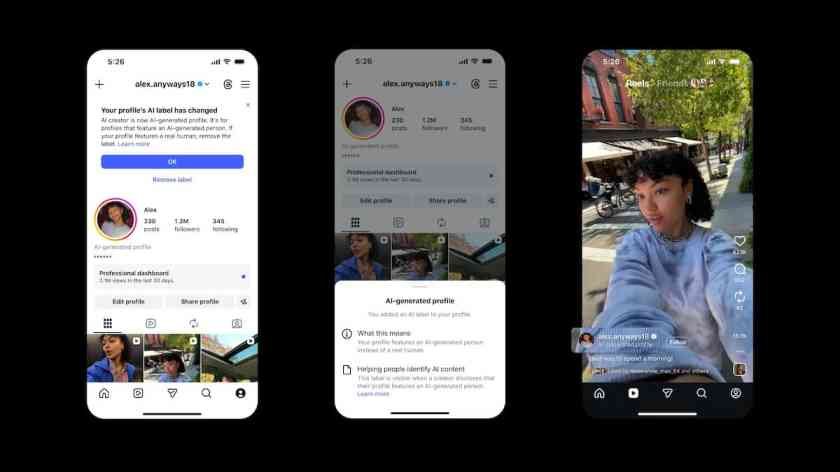
Instagram is introducing stricter rules for AI-generated profiles, requiring creators to clearly disclose when a person shown on a profile is substantially created by artificial intelligence.
Instagram is tightening its approach to AI-generated identities on the platform.
The social media company announced on August 31 that it is updating the way it labels profiles featuring AI-generated people. Under the new approach, Instagram will rename its existing “AI creator” label to “AI-generated profile” and may reduce the reach of accounts that fail to disclose when their profile subject is created with AI.
The move comes as AI-generated influencers and virtual personalities become increasingly common across social media. Instagram says the goal is to give people clearer information when a profile appears to represent a real person but actually features someone created or substantially generated using AI.
Instagram Introduces a Clearer AI Profile Label
The biggest change is the name of Instagram’s disclosure label.
The previous “AI creator” wording is being replaced with “AI-generated profile.” Instagram says the new wording is intended to make the disclosure easier for users to understand.
The label applies when the person featured on a profile is generated or substantially created using artificial intelligence.
For creators, there is an important distinction: using AI does not automatically mean a profile needs this label.
Instagram says creators who use AI for tasks such as editing photographs, improving captions, creating graphics, or making other creative adjustments do not necessarily need to identify their account as an AI-generated profile.
The focus is instead on profiles where the person themselves is substantially generated by AI.
Undisclosed AI Profiles Could Lose Reach
Instagram’s new policy also introduces a potential consequence for creators who do not properly disclose AI-generated people.
Accounts that fail to use the appropriate label could have their reach reduced, meaning their posts may be shown to fewer people through Instagram’s recommendation systems.
On the other hand, Instagram says creators will not be penalized simply because they use an AI-generated person if they properly disclose it.
That distinction could become increasingly important as virtual influencers and AI-generated personalities become more sophisticated.
For users, the change is mainly about transparency. An account can look like an ordinary profile at first glance, and it may not be immediately obvious that the person shown in the photos or videos does not actually exist.
Instagram says it has received feedback from people who were uncomfortable discovering later that a seemingly real person was entirely AI-generated.
Why Instagram Is Making the Change
AI-generated influencers have become a growing part of the social media ecosystem.
While virtual characters have existed for years, newer generative AI tools have made it much easier to create realistic-looking people, photographs, videos and social profiles at scale.
That has created new opportunities for creators and businesses, but it has also raised questions about transparency and trust.
The concern becomes even more serious when AI-generated personalities are used to promote products, services or advice.
Health and wellness content is one example. AI-generated doctors, wellness personalities and other fictional experts can potentially appear convincing to users who may not realize that the person behind the account is not real.
That creates a risk when such accounts make claims about health products, supplements or treatments.
For social media platforms, the challenge is finding a balance between allowing people to experiment with AI and making sure users are not misled.
AI Content Rules Are Becoming More Important
Instagram’s latest policy is part of a broader shift in how major platforms are dealing with synthetic media.
The technology behind AI-generated images, video and digital characters is improving quickly. As a result, simply looking at a photograph is becoming less reliable as a way to determine whether something is real.
Clear labels can give users additional context before they interact with an account or trust its content.
Instagram’s approach also suggests that platforms may increasingly focus on disclosure rather than banning AI-generated content altogether.
Creators can still use AI-generated people, but they are expected to be transparent when the AI-generated identity is a central part of the profile.
This could eventually influence how AI influencers build audiences, work with brands and monetize their content.
What This Means for AI Creators
For creators using AI-generated characters, the new Instagram policy is relatively straightforward: transparency matters.
If an account features a person who is substantially generated by AI, creators should use Instagram’s appropriate disclosure tools rather than presenting the character as a real human without clarification.
Creators who simply use AI as an editing or production tool are treated differently under the new guidance.
That means someone using AI to remove objects from photographs, improve an image, write a caption or create visual effects does not necessarily need to identify their entire profile as AI-generated.
The distinction is important because AI is becoming part of ordinary content creation. Not every use of artificial intelligence changes the identity or authenticity of the person featured in the content.
The Bigger Picture
Instagram’s move highlights a larger issue facing the social media industry: how should platforms handle people who do not actually exist?
AI-generated influencers can be entertaining and useful for creative projects, advertising and storytelling. But when realistic virtual personalities are presented without disclosure, users may have difficulty understanding what they are actually seeing.
Clear labeling could help reduce that confusion.
At the same time, the effectiveness of Instagram’s policy will depend on how consistently the platform identifies undisclosed AI-generated profiles and applies its reach restrictions.
For now, the message from Instagram is clear: AI-generated people are allowed, but creators should not hide the fact that they are AI-generated when the profile substantially depends on an artificial identity.
As generative AI becomes more deeply integrated into social media, transparency is likely to become just as important as creativity.
Read More on VitalStack
Enjoyed this article?
Subscribe for weekly deep-dives on AI and health — straight to your inbox.