
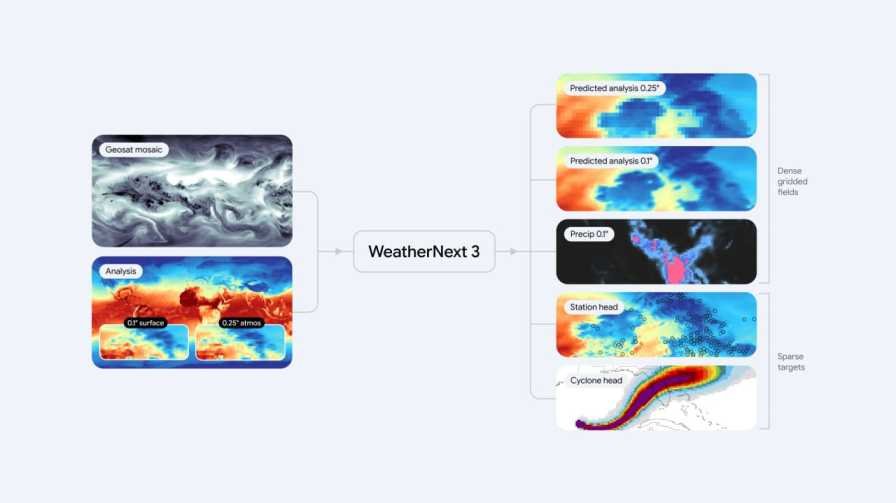
Google DeepMind and Google Research have introduced WeatherNext 3, a new artificial intelligence model designed to make global weather forecasting faster, more detailed, and more accurate.
The model represents another major step in the growing use of AI for meteorology. Google says WeatherNext 3 will eventually help power weather-related information across products such as Google Search, Google Maps, and Gemini. Researchers and developers will also be able to access the technology through Google’s cloud platforms.
WeatherNext 3 Improves AI Weather Forecasting
WeatherNext 3 has been tested against several leading weather prediction systems using Operational WeatherBench, a platform designed to compare forecasting models.
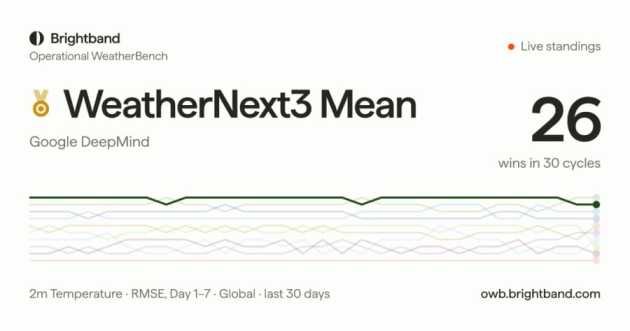
According to Google, the new model performed better than other AI-based forecasting systems from companies and organizations including Google, Microsoft, NVIDIA, and the European Centre for Medium-Range Weather Forecasts (ECMWF).
The model was also reported to outperform some traditional forecasting systems on measurements such as temperature, wind speed, and humidity.
This is significant because conventional weather forecasting has traditionally depended on powerful government and research supercomputers that process large amounts of atmospheric data using complex physical equations.
AI models take a different approach. Instead of calculating every part of the atmosphere from scratch, machine-learning systems can study large collections of historical weather data and learn patterns that can be used to generate forecasts more quickly.
More Detailed Forecasts and Better Rain Prediction
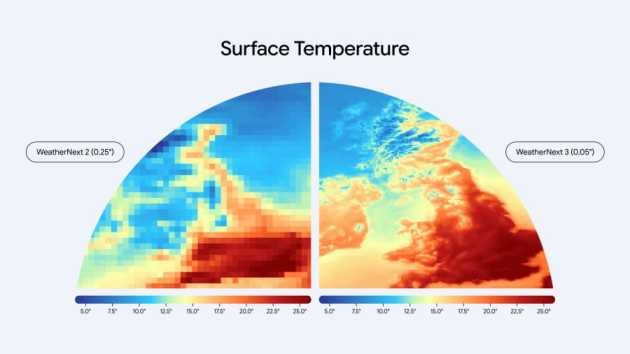
One of the biggest improvements in WeatherNext 3 is its ability to provide forecasts at a more detailed geographic scale.
Google says the model can produce forecasts at resolutions as fine as 5 kilometers for key weather variables, compared with the broader areas commonly associated with earlier AI forecasting systems.
Rain forecasting has also received a major upgrade. Google reports that WeatherNext 3 improves rainfall evaluation results by about 60% compared with WeatherNext 2.
The system can also generate hourly forecasts, rather than relying only on the six-hour forecasting intervals commonly used by many weather models.
More frequent and localized forecasts could be particularly useful for situations where weather can change quickly, including heavy rainfall, strong winds, storms, and other localized conditions.
WeatherNext 3 Uses More Real-Time Weather Data
Another important change is how the model processes information.
WeatherNext 3 can use weather observations collected from satellites in near real time. Google says this allows the system to work with hourly observations rather than relying entirely on processed datasets created by traditional forecasting systems.
Using raw observations is technically challenging because weather information comes from many different sources and formats. Turning that information into something an AI model can understand requires sophisticated data-processing systems.
Google describes WeatherNext 3 as its first AI weather model capable of directly incorporating raw observations for a high-resolution global forecast.
However, the company is not alone in working toward this approach. Other AI weather companies have also been experimenting with models that incorporate direct observations from sources such as weather balloons and other sensors.
A Larger Model With More Parameters
WeatherNext 3 is also considerably larger than its predecessor.
According to Google researchers, the new model contains 2.4 times more parameters than WeatherNext 2. The architecture has also been adjusted so different parts of the system can produce information that is more useful for specific forecasting tasks.
The researchers have also focused on making forecasts useful at individual weather stations.
That could allow the system to estimate conditions at specific locations, such as an airport weather station, rather than only providing broad atmospheric measurements across a large geographic grid.
This type of forecasting could make AI weather systems more practical for industries and organizations that need highly localized information.
Why AI Weather Forecasting Matters
Weather forecasting is not simply about deciding whether to carry an umbrella. Accurate predictions can affect agriculture, transportation, emergency planning, energy production, and many other industries.
For farmers, better rainfall and temperature forecasts can support decisions about irrigation, planting, and harvesting.
Renewable energy companies can also benefit from more detailed predictions of wind, cloud cover, and rainfall. Better forecasts can make it easier to estimate how much electricity solar and wind installations may produce.
There is also a potential benefit for regions where access to expensive weather supercomputers and high-quality observation infrastructure is limited.
AI forecasting systems can potentially produce predictions with less computing power and at lower cost once the models have been trained. That could help make advanced forecasting technology more accessible.
AI Is Changing Weather Forecasting
The development of WeatherNext 3 reflects a broader shift in meteorology.
For decades, numerical weather prediction has relied heavily on physical models running on large computing systems. These systems remain extremely important and have become highly accurate over time.
AI is now being used alongside those traditional approaches and, in some areas, is beginning to challenge them.
The rapid development of transformer-based machine-learning models has helped accelerate this change. Weather agencies and private companies are increasingly exploring AI because these systems can generate forecasts quickly and handle enormous amounts of historical and real-time information.
However, AI weather forecasting still has challenges. Models need reliable observations, strong validation, and careful testing against real-world conditions. Extreme weather events can also be particularly difficult to predict.
What WeatherNext 3 Means for Everyday Users
For everyday users, the biggest impact may eventually be relatively simple: better weather information when and where it is needed.
Google says WeatherNext 3 will contribute to weather information shown through Google Search, Google Maps, and Gemini.
That could make weather updates more detailed and timely, particularly when users are asking about conditions in specific locations.
The technology could also have a much broader impact behind the scenes, supporting businesses, researchers, emergency planners, farmers, and energy companies that depend on reliable weather forecasts.
The Bigger Picture
WeatherNext 3 shows how artificial intelligence is moving beyond chatbots and image generators into scientific applications with real-world consequences.
Better weather forecasting could help people prepare for changing conditions while also supporting agriculture, renewable energy, transportation, and disaster planning.
AI will not replace traditional meteorology overnight, but models such as WeatherNext 3 show how machine learning can become an increasingly important part of the forecasting process.
Read More on VitalStack
Enjoyed this article?
Subscribe for weekly deep-dives on AI and health — straight to your inbox.