

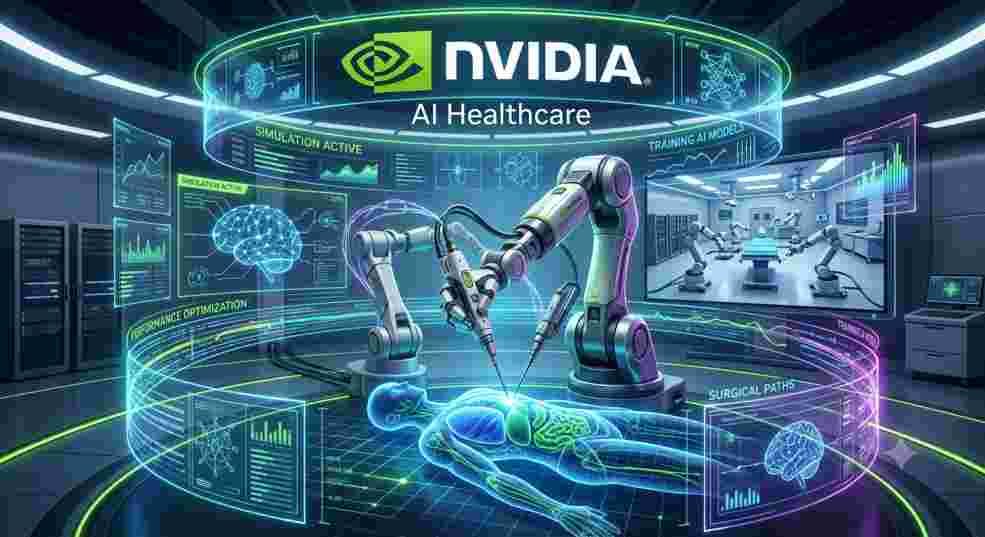
Nvidia has introduced a new artificial intelligence framework designed to help healthcare robots learn complex medical procedures in realistic virtual environments before being used in hospitals.
The new system, called Medical Physics Simulation, is part of Nvidia’s Isaac for Healthcare platform and focuses on training robots through realistic physical interactions instead of traditional programming alone.
This approach represents a major step toward what Nvidia calls Physical AI. AI systems that learn by interacting with their environment, much like humans do.
Why Healthcare Robots Need Better Training
Training medical robots in real hospitals is extremely difficult. Every surgical procedure is unique, patient safety comes first, and regulations limit how much experimental learning can happen during actual treatments.
To solve this challenge, Nvidia’s platform creates highly realistic medical simulations where robots can practice thousands of procedures without putting patients at risk.
These virtual environments allow robots to experience situations such as:
- Navigating delicate blood vessels
- Handling surgical instruments
- Detecting unusual tissue behavior
- Responding to rare medical complications
Instead of waiting years to collect real-world medical cases, developers can generate them instantly inside a simulation.
AI and Physics Working Together
The platform combines two advanced technologies:
- Physics-based simulation, which accurately models how medical tools and human tissue interact.
- Generative AI, which creates realistic patient anatomy, surgical environments, and visual variations.
This combination helps robots learn not only how medical devices move but also how different patients may respond during procedures.
According to Nvidia, the platform can run thousands of simulations simultaneously using its GPU technology, dramatically reducing AI training time compared to traditional methods.
Healthcare Companies Are Already Exploring the Technology
Several healthcare and medical technology companies are already evaluating the new platform for future robotics development.
These include organizations working on:
- Robotic surgery systems
- Catheter navigation
- Endovascular procedures
- Kidney stone treatment
- Medical device validation
Many of these companies are using synthetic medical data to improve robot training before conducting clinical testing.
However, these projects are still in the research and development stage, and no AI-trained robotic system from this framework has yet been approved for treating patients.
Faster Development, But Clinical Testing Remains Essential
While simulation can significantly speed up AI development, experts note that virtual training cannot completely replace real-world clinical validation.
Healthcare robots must still undergo extensive regulatory testing before they can safely assist doctors during medical procedures.
Simulation helps developers discover potential issues earlier, reduce development costs, and improve system reliability, but final approval still depends on clinical evidence and regulatory review.
Stay updated with the VitalStack.
Read More on VitalStack
- If You Pay a Hacker’s Ransom, They May Come Back for More, New Report Warns
- Anthropic Acquisition Rumor Around Physical Intelligence Sparks AI Industry Buzz
- Meta Tests AI Bedtime Story App That Creates Personalized Stories for Kids
- YouTube Tightens AI Content Monetization Rules to Reduce Low-Quality Videos
- CrowdStrike Discovers New AI Malware That Secretly Targets Software Development Systems
Enjoyed this article?
Subscribe for weekly deep-dives on AI and health — straight to your inbox.