
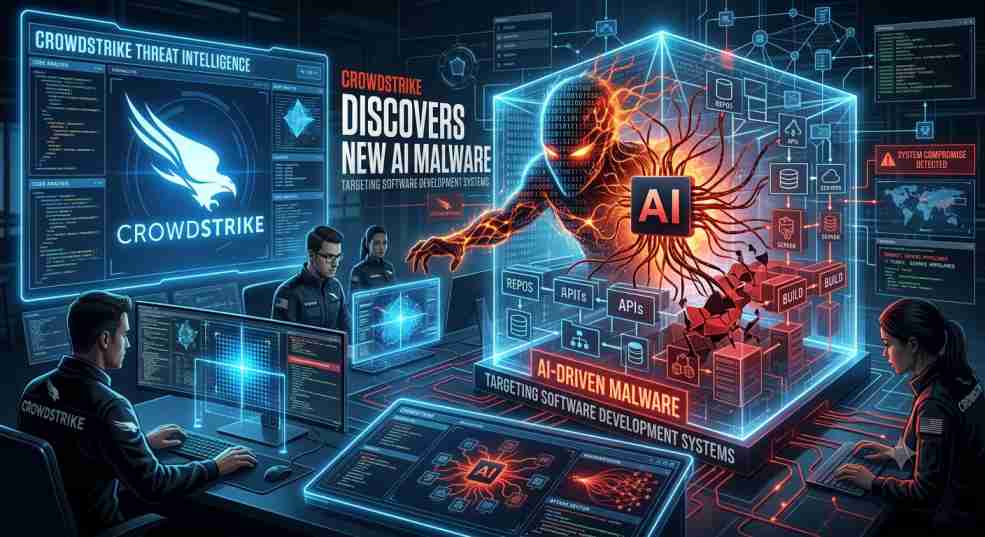
As artificial intelligence becomes a bigger part of software development, cybersecurity experts are warning about a dangerous new type of malware specifically built to attack AI development environments.
Security researchers at CrowdStrike have identified a sophisticated malware campaign that targets AI-powered coding systems and software development infrastructure. The malware is designed to quietly steal login credentials, collect sensitive information, and even destroy important files while remaining extremely difficult to detect.
The discovery highlights a growing cybersecurity challenge as more organizations rely on AI tools to write, review, and manage software.
Malware Designed for AI Development Platforms
According to CrowdStrike researchers, the newly discovered malware behaves like a worm, meaning it can spread through development environments while hiding among legitimate automated processes.
Instead of attacking traditional office computers, this malware focuses on AI-powered coding pipelines where developers store source code, software packages, authentication tokens, and cloud credentials.
Because AI coding assistants perform many automated tasks, the malicious software blends in with normal system activity, making it much harder for security teams to identify suspicious behavior.
How the Attack Works
Researchers say the malware follows several stages after infecting a system.
It first scans the environment to understand the victim’s infrastructure. Once it gathers enough information, it searches for valuable assets such as:
- Developer login credentials
- API keys
- Cloud access tokens
- Cryptographic keys
- Software package manager credentials
- Source code access permissions
As the malware gains higher system privileges, it continues collecting sensitive data that attackers can later use to access internal systems or launch additional attacks.
Hidden “Death Switch” Can Destroy Files
One of the most concerning features of the malware is what researchers describe as a built-in “death switch.”
If activated, the malware can delete important files, disrupt development environments, and even prevent legitimate users from accessing affected systems.
This destructive capability makes the threat far more serious than traditional information-stealing malware.
Difficult to Detect
Security experts explain that detecting this malware is especially challenging because it imitates normal AI development workflows.
Modern AI coding assistants automatically perform tasks like downloading packages, updating code, and interacting with software repositories. The malware uses similar behavior, allowing it to remain hidden inside everyday development operations.
Researchers also found that the malware intentionally delays some of its actions for hours or even days after infection, making it difficult for investigators to connect the attack to its original source.
AI Supply Chain Security Is Becoming More Important
The discovery is another reminder that AI software supply chains are becoming attractive targets for cybercriminals.
As organizations increasingly depend on AI coding assistants, protecting development environments is becoming just as important as securing traditional business networks.
Cybersecurity experts recommend stronger access controls, continuous monitoring, credential protection, and regular security reviews to reduce the risk of AI-related attacks.
Stay updated with the VitalStack.
Read More on VitalStack
- Google Reportedly Developing New AI Chip to Make Gemini Faster and More Efficient
- Apple Face ID Co-Inventor Builds AI Tool to Detect Brain Disorders Without Surgery
- Prompt Injection Attacks Are Now Stopping Malicious AI Hacking Bots
- Google Changes Gemini AI Usage Limits: Here’s What Every User Needs to Know
- AWS and Bluesight Launch AI Tool to Simplify Hospital 340B Compliance
Enjoyed this article?
Subscribe for weekly deep-dives on AI and health — straight to your inbox.