
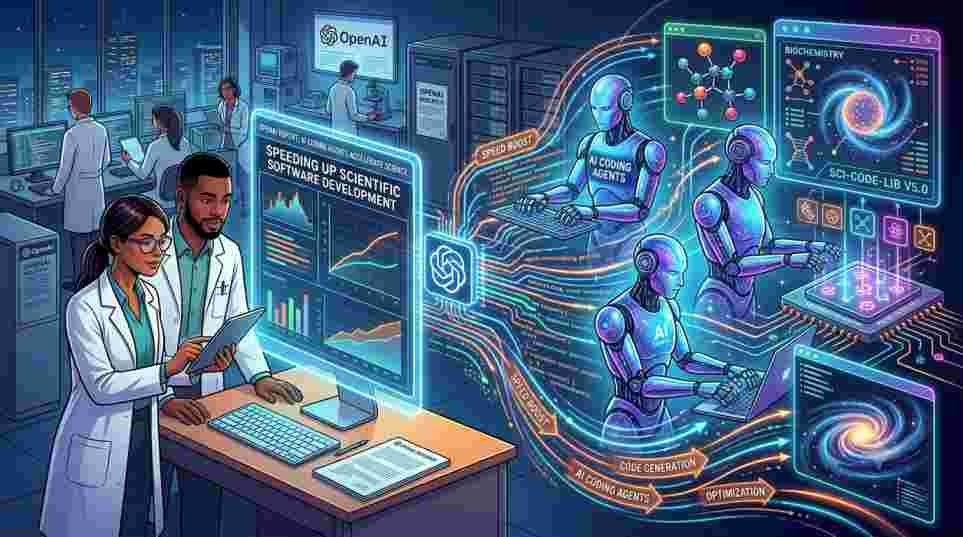
OpenAI has released a new field report highlighting how AI coding agents are helping researchers develop and improve scientific software more quickly. The report examines eight real-world scientific computing projects where AI-assisted coding reduced software development time, improved performance, and modernized research tools used in healthcare, genomics, and data science.
According to OpenAI, researchers used its AI coding assistant Codex in five projects, while three projects combined Codex with Anthropic’s Claude Code to solve complex programming challenges.
Although the report is based on OpenAI-supported case studies, it offers new insights into how AI coding assistants are becoming valuable tools for scientific research teams.
AI Helped Modernize Research Software
Many scientific software projects are created by small research teams and often receive limited long-term maintenance after publication. As programming languages evolve and operating systems change, these research tools can become difficult to update and maintain.
OpenAI’s report suggests that AI coding agents can reduce this maintenance burden by automatically handling repetitive development tasks such as code optimization, software migration, debugging, packaging, and build system improvements.
Instead of replacing researchers, AI is being used to speed up technical work so scientists can spend more time focusing on research.
Faster Performance Across Multiple Research Projects
The report highlights several examples where AI coding agents significantly improved software performance.
One genomics tool, HI.SIM, achieved a 31% reduction in runtime after AI-assisted optimization without changing its scientific results.
Another genome assembly application, Hifiasm, recorded approximately 25% faster performance during benchmark testing, with additional improvements seen when processing human genome sequencing data.
Researchers explained that AI helped identify optimization opportunities automatically, while human experts continued to review and validate the final results.
AI Also Assisted Large Software Rebuilds
Beyond performance improvements, AI coding agents also helped developers modernize older scientific software.
In one project, researchers successfully migrated MHCflurry, a machine learning tool used to predict immune system responses, from TensorFlow to PyTorch while maintaining compatibility with existing trained models.
Another project involved rebuilding an abandoned RNA sequencing tool using the Rust programming language. Developers said AI dramatically reduced the time required for what would otherwise have been a massive software engineering effort.
According to contributors, tasks that once required months of manual programming could now be completed in weeks with AI assistance and expert supervision.
Massive Speed Improvements in RNA Sequencing
One of the most significant improvements came from a project called RustQC, which combines multiple RNA sequencing quality-control tools into a single application.
Researchers reported that the updated software processed data up to 60 times faster while significantly reducing disk usage.
Additional companion tools also showed notable performance gains while maintaining compatibility with existing scientific workflows.
These improvements could help researchers analyze biological data more efficiently, particularly in large-scale genomics studies.
Human Experts Still Play the Most Important Role
Despite the impressive results, OpenAI’s report makes it clear that AI coding agents are not replacing scientists or software engineers.
Researchers repeatedly emphasized that AI-generated code must be carefully reviewed before being used in scientific research.
While AI can generate code quickly, it cannot determine whether scientific results are correct.
Instead, human experts remain responsible for:
- Validating research findings
- Reviewing AI-generated code
- Running benchmark tests
- Identifying numerical errors
- Confirming scientific accuracy
Several contributors noted that AI occasionally produced incorrect solutions with high confidence, making thorough human verification essential.
AI Is Changing How Research Software Is Built
The report suggests that AI coding assistants are making ambitious software projects more practical for smaller research teams.
Instead of hiring dedicated software engineers for every project, scientists can now use AI to accelerate development while focusing their expertise on scientific decision-making and quality assurance.
However, researchers also warned that AI could lead to multiple versions of the same software being developed independently, potentially creating compatibility issues across research communities if projects are not properly maintained.
Stay updated with the VitalStack.
Read More on VitalStack
- Google AI Overviews Now Appear in Nearly Half of Search Results, Changing How People Search Online
- Snapchat Stops Rewarding Fully AI-Generated Spotlight Videos to Promote Original Creators
- OpenAI Launches Presence: Enterprise AI Agents Backed by Dedicated Engineers
- Can Brainwave Data Make AI Robots Smarter? Startups Are Exploring a New Training Method
Enjoyed this article?
Subscribe for weekly deep-dives on AI and health — straight to your inbox.