
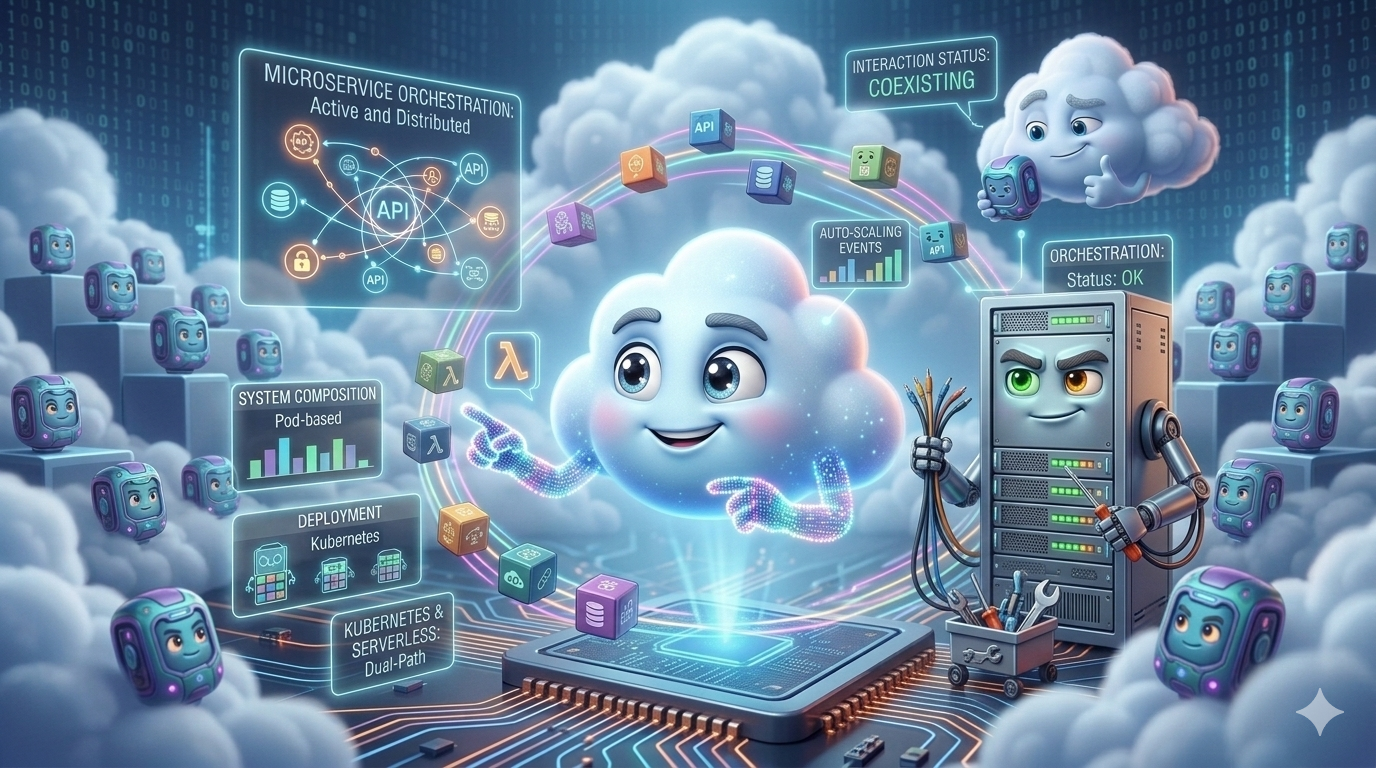
Introduction
Over the last few years, backend development has changed dramatically. Developers are no longer limited to managing physical servers or complex infrastructure. With the rise of cloud computing, many teams are moving toward serverless architecture to build scalable applications faster.
But does that mean traditional backend systems are becoming obsolete?
Not really.
In 2026, developers and startups still face an important architecture decision: should you use serverless infrastructure or stick with a traditional backend setup?
Both approaches have advantages depending on your project size, scalability needs, and development workflow. In this guide, we will compare serverless vs traditional backend architecture, explore real-world use cases, and help you decide which approach makes the most sense for your application.
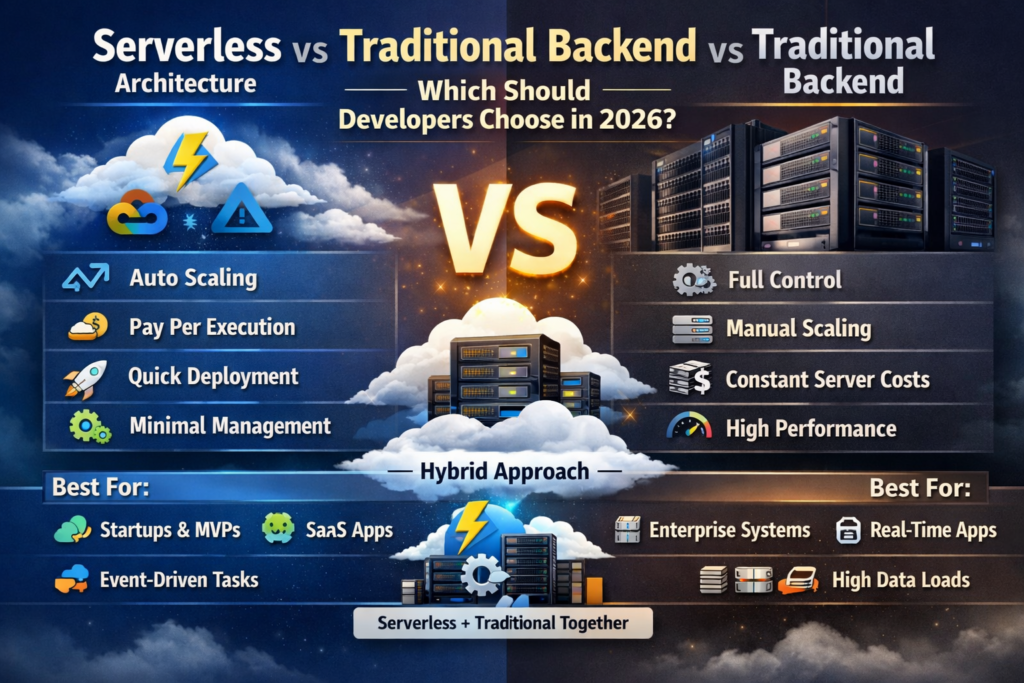
What Is a Traditional Backend?
A traditional backend refers to a server-based architecture where developers manage the infrastructure that runs the application.
This typically includes:
- Application servers
- Databases
- Load balancers
- APIs
- Hosting infrastructure
Developers deploy backend applications on servers using technologies such as:
- Node.js
- Java
- Python
- PHP
- Ruby
These servers are hosted on platforms like:
- Amazon Web Services
- Google Cloud
- Microsoft Azure
In this model, developers are responsible for managing:
- Server configuration
- Scaling infrastructure
- Security patches
- Performance optimization
While this approach offers maximum control, it also requires more operational work.
What Is Serverless Architecture?
Serverless architecture is a cloud computing model where developers build applications without managing servers directly.
Instead of running a continuously active server, serverless systems execute code only when events occur.
These small pieces of code are called functions, and they automatically scale depending on demand.
Popular serverless services include:
- AWS Lambda
- Google Cloud Functions
- Azure Functions
In a serverless environment:
✔ No server management
✔ Automatic scaling
✔ Pay only for usage
✔ Faster deployment
This approach has become extremely popular for modern SaaS platforms and startups because it significantly reduces infrastructure complexity.
Key Differences: Serverless vs Traditional Backend
| Feature | Serverless Architecture | Traditional Backend |
|---|---|---|
| Infrastructure | Managed by cloud provider | Managed by developers |
| Scaling | Automatic | Manual scaling required |
| Cost Model | Pay per execution | Pay for server uptime |
| Deployment | Faster and simpler | More configuration needed |
| Control | Limited infrastructure control | Full control over environment |
Both architectures can support large-scale applications, but the development experience and operational workload differ significantly.
When Serverless Is the Better Choice
Serverless architecture works best for applications that need flexibility, fast development, and automatic scaling.
Common serverless use cases include:
Startup MVPs
Startups often choose serverless to build products quickly without worrying about infrastructure.
SaaS Platforms
Many SaaS tools rely on serverless APIs to handle dynamic workloads.
Event-Driven Applications
Examples include:
- File processing
- Notifications
- Automation systems
- Background jobs
AI and Automation Tools
Serverless functions are widely used to power AI APIs, automation tools, and data processing systems.
Because these workloads are unpredictable, serverless platforms can scale instantly based on demand.
When Traditional Backend Is the Better Choice
Despite the popularity of serverless computing, traditional backend systems remain essential for many applications.
Here are some cases where a traditional backend is often the better choice.
Large Enterprise Systems
Enterprise platforms usually require complex infrastructure control, which is easier with traditional servers.
Real-Time Applications
Applications such as:
- Online gaming
- Financial trading platforms
- Real-time messaging systems
often require persistent connections that serverless functions cannot easily maintain.
High Database Workloads
Applications that constantly read and write large volumes of data may perform better with a dedicated backend server.
Performance and Scalability Comparison
Both serverless and traditional backend architectures can scale to millions of users, but they do so differently.
Serverless
- Instant auto-scaling
- Handles unpredictable traffic well
- Ideal for burst workloads
Traditional Backend
- Requires load balancing
- Scaling must be configured manually
- Better for long-running processes
For many modern web applications, serverless offers simpler scalability, which is why startups often adopt it first.
Real-World Use Cases
Many companies combine both architectures to get the best of each approach.
For example:
- Large APIs run on traditional servers
- Background tasks run on serverless functions
- Image processing pipelines run serverless
This hybrid architecture allows teams to optimize performance and cost simultaneously.
Serverless vs Traditional Backend: Final Comparison
| Category | Winner |
|---|---|
| Ease of Development | Serverless |
| Infrastructure Control | Traditional Backend |
| Cost Efficiency for Small Apps | Serverless |
| Long Running Processes | Traditional Backend |
| Startup Projects | Serverless |
In reality, most modern systems combine both architectures together.
Which Architecture Should You Choose in 2026?
If you are building a modern application today, here is a simple guideline.
Choose serverless if:
- You are building a startup or MVP
- You want fast deployment
- Your traffic is unpredictable
- You want minimal infrastructure management
Choose a traditional backend if:
- Your system requires heavy database workloads
- You need full infrastructure control
- Your application runs long processes
For many teams, the best solution is a hybrid architecture that combines both models.
Future of Backend Development

Backend development in 2026 is moving toward cloud-native architectures.
Developers are increasingly adopting:
- serverless computing
- microservices architecture
- container-based infrastructure
- scalable cloud platforms
This shift allows teams to build high-performance applications with less operational complexity.
Understanding the difference between serverless vs traditional backend architecture is now an essential skill for modern developers.
FAQ: Serverless vs Traditional Backend
Is serverless cheaper than traditional backend?
Serverless can be cheaper for small applications because you only pay for the compute time used. However, high-traffic systems may sometimes become expensive if not optimized.
Is serverless good for startups?
Yes. Many startups choose serverless because it reduces infrastructure management and allows teams to focus on product development.
Can large applications use serverless?
Yes. Many modern applications combine serverless services with traditional backend infrastructure to build scalable systems.
🔗 Recommended Backend Development Guides
If you want to deepen your knowledge about backend development and modern system architecture, explore these detailed guides from VitalStack:
- Best Backend Frameworks in 2026: Performance, Scalability & Career Growth Guide
- Microservices vs Monolith in 2026: Which Architecture Should You Choose?
These guides explain backend frameworks, architecture decisions, and modern cloud infrastructure trends that developers need to understand in 2026.
🌍 Useful External Resources
For deeper technical documentation and cloud architecture knowledge, you can also explore these official resources:
- AWS Lambda Documentation
https://aws.amazon.com/lambda - Google Cloud Functions Guide
https://cloud.google.com/functions - Microsoft Azure Serverless Computing
https://azure.microsoft.com/en-us/solutions/serverless/
These resources provide official documentation for building scalable serverless applications.
Enjoyed this article?
Subscribe for weekly deep-dives on AI and health — straight to your inbox.