
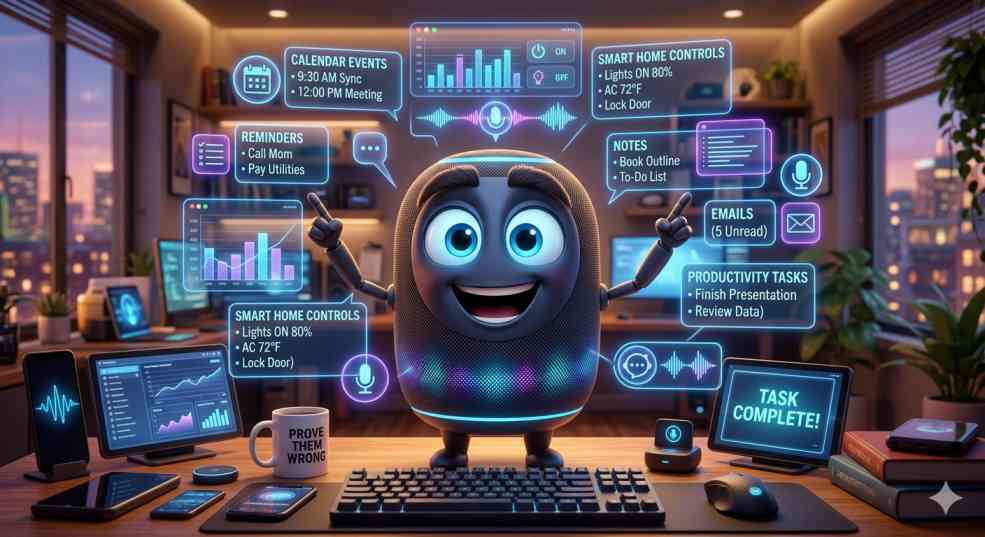
Introduction
A few years ago, I only used voice assistants for very simple tasks.
Things like:
- Setting alarms
- Checking the weather
- Playing music
- Creating reminders
Honestly, I didn’t think they were particularly useful.
Most conversations felt robotic, and the assistant often misunderstood what I was trying to say.
Fast forward to today, and my experience is completely different.
Modern Voice AI can understand context, answer follow-up questions, summarize information, and even help manage tasks.
Over the past few months, I’ve experimented with voice-based AI while researching articles, organizing daily work, and testing productivity workflows.
The results were surprisingly practical.
What impressed me wasn’t that Voice AI could answer questions.
It was that it started feeling like a genuine assistant rather than a simple tool.
Why Voice AI Is Becoming More Popular
People naturally communicate through speech.
Speaking is usually faster than typing.
This becomes especially useful when:
- Driving
- Cooking
- Walking
- Exercising
- Multitasking
Instead of opening an app, typing a question, and searching through results, users can simply ask.
That convenience is one of the biggest reasons Voice AI adoption continues to grow.
My One-Week Voice AI Productivity Test
To understand whether Voice AI could actually improve productivity, I conducted a simple experiment.
For one week, I used voice commands whenever possible.
Tasks Included
- Creating reminders
- Adding calendar events
- Taking notes
- Researching quick questions
- Managing daily tasks
Before Using Voice AI
Average administrative work:
45 – 50 minutes daily
After Using Voice AI
Average administrative work:
25 – 30 minutes daily
Biggest Observation
The benefit wasn’t just speed.
It was convenience.
Instead of stopping what I was doing to type something, I could simply speak naturally.
Real Example: Voice AI in Daily Work
While brainstorming content ideas for VitalStack, I often think of topics while away from my desk.
Before Voice AI, those ideas were easy to forget.
Now I simply dictate:
“Remind me to write about AI productivity tools.”
or
“Create a note about future voice technology trends.”
Within seconds, the idea is stored and organized.
Small improvements like this add up over time.
The Next Generation of Smart Assistants
Today’s assistants answer questions.
Tomorrow’s assistants may complete entire workflows.
Imagine saying:
“Schedule a meeting with my marketing team next week and prepare a summary of our last discussion.”
Instead of giving step-by-step instructions, the assistant could handle the complete process.
Future Capabilities Could Include
- Managing emails
- Scheduling appointments
- Conducting research
- Creating reports
- Booking travel
- Organizing projects
This is where Voice AI becomes much more than a voice-controlled search engine.
Smart Homes Are Getting Smarter
One area where Voice AI is already making a noticeable impact is smart homes.
Many people currently use voice assistants to control:
- Lights
- Air conditioning
- Security cameras
- Entertainment systems
But future systems may become more proactive.
Example
Imagine arriving home after work.
Your assistant already knows:
- Your preferred room temperature
- Your favorite evening playlist
- Your lighting preferences
Instead of waiting for commands, it adjusts automatically.
This creates a more personalized experience.
Voice AI in Customer Support
Businesses are also adopting Voice AI rapidly.
Traditional customer service often involves long wait times and complicated menus.
Modern Voice AI systems can understand natural language and respond more effectively.
Real-World Scenario
Instead of hearing:
“Press 1 for billing.”
Customers can simply explain their problem in their own words.
The system understands the request and directs them to the correct solution.
This saves time for both customers and businesses.
Challenges That Still Exist
Voice AI has improved dramatically, but it isn’t perfect.
During testing, I occasionally noticed:
- Accent recognition issues
- Background noise problems
- Incorrect interpretations
- Limited understanding of complex context
Technology is improving quickly, but these challenges still exist.
That’s why human oversight remains important.
Privacy Concerns Matter
Whenever a device listens to voice commands, privacy becomes a legitimate concern.
Many users wonder:
- Is my voice being stored?
- How is the data used?
- Who has access to conversations?
Companies developing Voice AI must continue improving transparency and privacy controls.
User trust will play a major role in future adoption.
What the Future Might Look Like
The future of Voice AI isn’t just about better speech recognition.
It’s about creating assistants that understand intent.
Instead of responding to commands, future systems may proactively help users complete goals.
That shift could change how we interact with technology forever.
Final Thoughts
After spending time testing Voice AI tools, one thing became clear.
We’re moving beyond simple voice commands.
The technology is becoming more conversational, more intelligent, and more capable of helping people in everyday life.
While there are still limitations, the progress over the last few years has been remarkable.
Conclusion
Voice AI and smart assistants are evolving into powerful productivity tools.
From managing schedules and organizing information to controlling smart homes and supporting businesses, the technology is becoming increasingly useful.
The most exciting part is that we’re still early in the journey.
The next generation of Voice AI may not just answer questions it may help us accomplish meaningful work every day.
FAQ’s
What is Voice AI?
Voice AI is technology that allows computers and digital assistants to understand, process, and respond to spoken language.
How are smart assistants improving?
Modern assistants can understand context, handle complex requests, and assist with productivity tasks rather than just answering basic questions.
Can Voice AI improve productivity?
Yes. Voice AI can reduce time spent on routine tasks such as scheduling, note-taking, reminders, and information searches.
Is Voice AI safe to use?
Most platforms include privacy settings and security features, but users should always review data collection policies.
What industries benefit most from Voice AI?
Customer support, healthcare, education, smart homes, content creation, and business productivity are among the biggest beneficiaries.
Read More on VitalStack
Enjoyed this article?
Subscribe for weekly deep-dives on AI and health — straight to your inbox.