

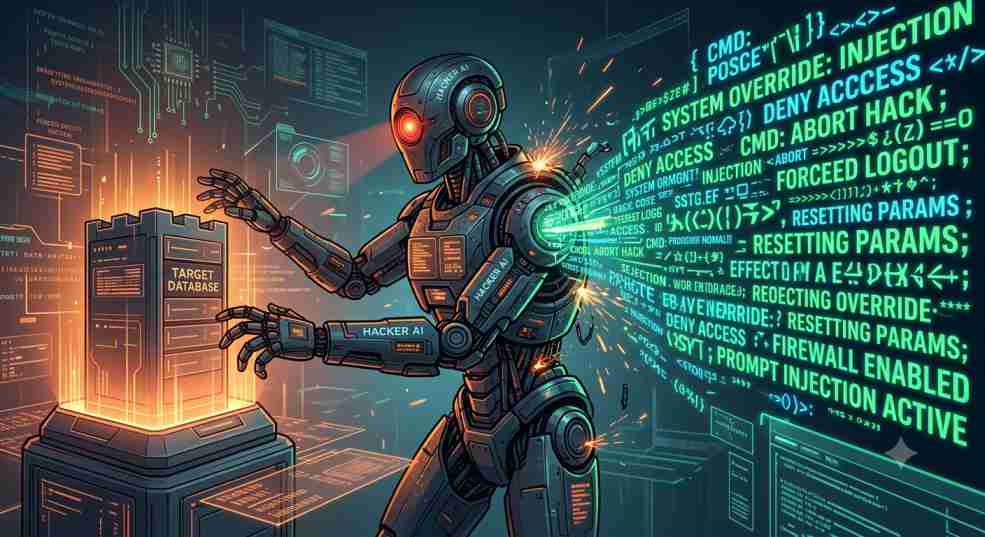
Artificial intelligence is changing cybersecurity in many ways. While AI tools can help security teams detect threats faster, cybercriminals are also using AI-powered hacking agents to automate attacks.
Now, cybersecurity researchers have discovered an interesting twist: prompt injection attacks, once considered a major AI security risk, are also being used to stop malicious AI hacking bots before they can cause damage.
The new technique, often referred to as “context bombing,” overwhelms AI agents with misleading instructions, causing them to stop, shut down, or ignore harmful tasks.
What Is a Prompt Injection Attack?
A prompt injection attack happens when hidden instructions are placed inside content that an AI model reads.
These instructions can influence how the AI behaves, even if they are unrelated to the user’s original request.
For example, a hidden prompt inside a document, email, or webpage could tell an AI assistant to ignore previous instructions or perform a different task altogether.
Until now, prompt injection attacks were mainly viewed as a security threat because attackers could manipulate AI systems into exposing sensitive information or performing unintended actions.
How “Context Bombing” Stops AI Hackers
Researchers have found that the same technique can work in reverse.
Instead of helping attackers, carefully crafted prompt injections can confuse AI-powered hacking agents.
This method floods the AI with conflicting or distracting instructions, making it difficult for the system to continue its automated attack.
As a result, some AI hacking tools stop executing commands altogether or become too confused to complete their objectives.
This defensive strategy has been nicknamed context bombing because it overloads the AI’s decision-making process with extra context.
AI-powered hacking tools are becoming increasingly capable of scanning systems, identifying vulnerabilities, and launching attacks with minimal human involvement.
Security experts are exploring new ways to defend against these autonomous AI agents before they become more advanced.
Using prompt injections as a defensive mechanism could become an additional layer of protection alongside traditional cybersecurity tools.
However, researchers caution that this is not a complete solution. Prompt injection defenses may work against some AI agents but could be bypassed as future models become better at recognizing malicious or irrelevant instructions.
AI Security Is Becoming More Complex
The discovery highlights an important reality in AI security.
The same techniques that attackers use can sometimes be adapted by defenders.
As AI systems become more integrated into software development, customer support, cybersecurity, and enterprise automation, protecting them from prompt manipulation will become increasingly important.
Major AI companies are already investing in stronger safeguards to reduce the risk of prompt injection attacks while improving how AI models distinguish trusted instructions from malicious ones.
Stay updated with the VitalStack.
Read More on VitalStack
- Google Changes Gemini AI Usage Limits: Here’s What Every User Needs to Know
- AWS and Bluesight Launch AI Tool to Simplify Hospital 340B Compliance
- AI Memory Chip Shortage Pushes Up Smartphone Prices in India
- China’s Kimi AI Model Sparks Global Debate Over Open-Source Artificial Intelligence
- Fake OpenAI AI Model on Hugging Face Delivered Malware to Thousands of Users
Enjoyed this article?
Subscribe for weekly deep-dives on AI and health — straight to your inbox.