

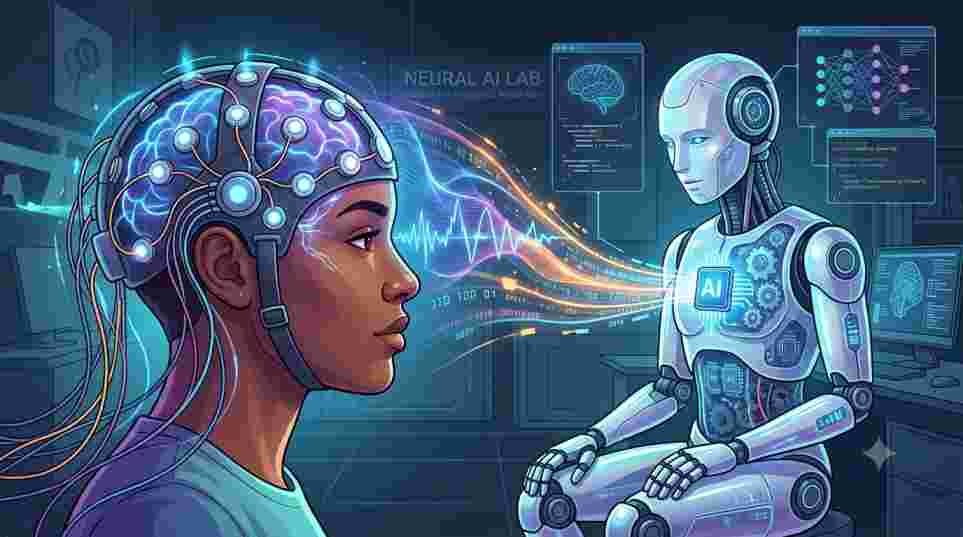
The race to build smarter AI-powered robots is entering a new phase. Instead of focusing only on bigger AI models, researchers are now looking at something much closer to humans the brain.
AI data company Encord is working with neuroscience startup Zander Labs to explore whether human brainwave data can help robots learn physical tasks more efficiently. The project could reshape how robots are trained for healthcare, manufacturing, warehouses, and even household jobs.
Rather than simply watching people perform tasks, future robots may also learn how humans think while completing them.
Why Physical AI Needs Better Training Data
Unlike chatbots that learn from billions of text documents, physical AI systems must understand movement, balance, touch, pressure, and coordination.
Training robots is much harder because they need real-world experience.
Developers currently collect data by recording humans performing tasks such as:
- Picking up objects
- Organizing shelves
- Pouring liquids
- Plugging in cables
- Sorting household items
However, experts say this data is still limited compared to what large language models receive during training.
Measuring Brain Activity During Everyday Tasks
To improve robot learning, Encord has started experimenting with wearable brainwave sensors.
During testing, human trainers perform tasks such as carefully removing wooden blocks from a Jenga tower while wearing a headset that records both eye movements and brain activity.
Researchers believe these brain signals can reveal:
- When a task becomes difficult
- When a person notices mistakes
- How much concentration is required
- Decision-making patterns
- Intent before movement
If successful, AI models could eventually understand not only what people do but also why they do it.
More Than Just Cameras
Modern robot training already uses multiple cameras to capture movements from different angles.
Now researchers are adding new data sources including:
- Brainwave monitoring
- Muscle activity sensors
- 3D hand tracking
- Robotic arm demonstrations
- Human-operated robot controls
These additional signals could give AI systems a much richer understanding of human actions.
Robots Are Learning Everyday Skills
Inside Encord’s robotics training facility, workers teach robots practical skills by demonstrating real-world activities.
Some examples include:
- Pouring coffee into cups
- Stacking poker chips
- Connecting Ethernet cables
- Organizing shelves
- Handling flowers and household objects
- Picking up delicate items
These demonstrations help robots improve their precision and coordination.
Why High-Quality Data Matters
According to researchers, collecting detailed training data is expensive, but it may be worth the investment.
Instead of relying on millions of random internet videos, companies are building carefully labeled datasets that describe every movement.
For example:
“Right hand picks up screwdriver.”
“Left hand tightens bolt.”
This type of structured information helps AI models understand both movement and context.
Building Physical AI Is Different From ChatGPT
Large language models were trained using enormous amounts of publicly available text.
Robotics doesn’t have that luxury.
Developers cannot simply download billions of examples showing humans performing every physical task.
Instead, every demonstration must be recorded, reviewed, labeled, and verified.
That makes physical AI one of the most data-intensive areas of artificial intelligence today.
The Future of Human-Like Robots
Researchers believe better training data could accelerate progress across many industries.
Future robots may assist with:
- Healthcare procedures
- Warehouse automation
- Manufacturing
- Home assistance
- Elderly care
- Retail operations
If brainwave-assisted training proves effective, robots could become faster learners while making fewer mistakes in complex environments.
Stay updated with the VitalStack.
Read More on VitalStack
- AI Security Guardrails Are Creating New Challenges for Cybersecurity Researchers
- OpenAI Expands ChatGPT Health to All U.S. Users Across Every Plan
- Meta’s New AI Campaign Sparks Debate Over Choice of David Bowie Song
- Google’s AI Investment Pays Off as Cloud Revenue Reaches Record High
- SenseTime Launches Galaxy Project to Strengthen China’s AI Chip Ecosystem
Enjoyed this article?
Subscribe for weekly deep-dives on AI and health — straight to your inbox.