Introduction
Modern applications rely heavily on APIs. Whether you’re building a SaaS platform, a mobile app, or a cloud-based service, APIs act as the communication bridge between systems.
Because of this, good API design is no longer optional. Poorly designed APIs can cause performance issues, security vulnerabilities, and scalability problems as your application grows.
In 2026, developers are focusing on building APIs that are not only functional but also scalable, secure, and developer-friendly.
In this guide, we’ll explore the most important API design best practices in 2026, along with real-world strategies used by modern backend teams.
Modern applications rely heavily on APIs. Whether you’re building a SaaS platform, a mobile app, or a cloud-based service, APIs act as the communication bridge between systems.
If you want to understand how backend systems work with APIs, you can also explore our guide on Best Backend Frameworks in 2026.
What Is an API?
An API (Application Programming Interface) allows different software systems to communicate with each other.
For example:
- A mobile app requesting data from a backend server
- A payment system processing transactions
- A cloud service interacting with microservices
APIs define how requests are sent and how responses are returned.
Without APIs, modern distributed systems would not function efficiently.
REST architecture follows standard HTTP methods defined by the web.
Learn more from the official REST guide by: https://restfulapi.net/
Why API Design Matters in 2026
Applications today are more complex than ever.
Modern systems often include:
- mobile applications
- web frontends
- microservices
- third-party integrations
- cloud infrastructure
A well-designed API ensures that all these components can communicate efficiently and reliably.
Good API design improves:
- application scalability
- system reliability
- developer productivity
- long-term maintainability
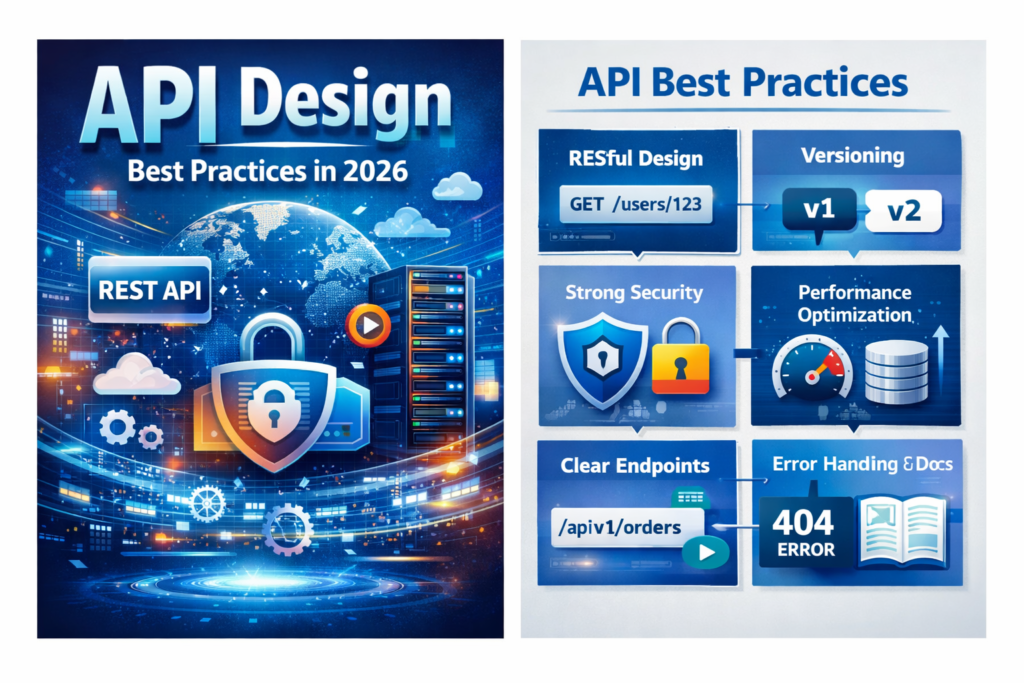
1. Use RESTful API Principles
Most modern APIs follow REST architecture because it is simple and widely supported.
REST APIs organize resources using standard HTTP methods.
Example:
GET /users
POST /users
PUT /users/{id}
DELETE /users/{id}
These operations clearly represent actions performed on resources.
Following REST principles makes APIs easier for developers to understand and integrate.
2. Design Clear and Consistent Endpoints
API endpoints should be predictable and structured logically.
Bad example:
/getUserData
Better example:
/users/{id}
Consistency helps developers integrate with your API quickly.
Good endpoint design also improves documentation clarity.
3. Implement Proper API Versioning
As applications evolve, APIs often require changes.
Without versioning, updates can break existing applications.
Common versioning strategies include:
/v1/users
/v2/users
API versioning allows developers to introduce improvements while maintaining backward compatibility.
This is especially important for SaaS platforms with many external integrations.
4. Focus on API Security
Security is one of the most critical aspects of API design.
Common API security practices include:
- Authentication using OAuth or JWT
- Rate limiting
- Input validation
- HTTPS encryption
APIs exposed publicly must always include authentication and request validation to prevent misuse.
Secure APIs protect both user data and system integrity.
5. Optimize API Performance
Performance becomes crucial when applications scale to thousands or millions of users.
Several strategies improve API performance:
- caching responses
- reducing payload size
- pagination for large datasets
- asynchronous processing
For example, instead of returning thousands of records, APIs should implement pagination:
GET /products?page=1&limit=20
This approach improves response time and reduces server load.
API performance also depends heavily on backend infrastructure. If you’re exploring modern backend architectures, read: Serverless vs Traditional Backend
6. Use Proper Error Handling
APIs should provide clear error messages so developers understand what went wrong.
Example:
{
 "error": "Invalid API key"
}
Standard HTTP status codes help communicate issues effectively.
Common examples include:
200 – Success
400 – Bad Request
401 – Unauthorized
404 – Not Found
500 – Server Error
Good error responses significantly improve the developer experience.
7. Provide Clear API Documentation
Even a powerful API becomes useless if developers cannot understand how to use it.
High-quality API documentation typically includes:
- endpoint descriptions
- request examples
- response examples
- authentication instructions
Many companies use tools such as Swagger or OpenAPI to automatically generate API documentation.
https://swagger.io/specification
Clear documentation encourages faster adoption of your API.
Backend Architecture and API Design
Modern APIs are often part of distributed architectures like microservices.
You can learn more about this architecture in our guide: Microservices vs Monolith in 2026
If you want to understand how APIs interact with different backend systems, you can explore these guides:
These articles explain how backend frameworks and architecture decisions influence API scalability.
Future Trends in API Development
API development continues evolving alongside cloud infrastructure.
Key trends shaping APIs in 2026 include:
- API-first development
- GraphQL adoption
- serverless APIs
- event-driven architectures
- AI-powered automation
Developers who understand modern API architecture will remain in high demand across startups and enterprise companies.
Final Thoughts
Designing APIs correctly is one of the most valuable skills for backend developers.
A well-designed API improves:
- scalability
- security
- developer productivity
- long-term system stability
By following the API design best practices outlined in this guide, developers can build backend systems that scale efficiently as applications grow.
Frequently Asked Questions
What is the most common API architecture?
REST APIs remain the most widely used API architecture because they are simple, scalable, and easy to integrate.
Are GraphQL APIs better than REST?
GraphQL provides more flexible data queries, but REST APIs remain simpler for most applications.
Why is API versioning important?
API versioning allows developers to update APIs without breaking existing integrations.
Enjoyed this article?
Subscribe for weekly deep-dives on AI and health — straight to your inbox.