
Introduction
Imagine a doctor in a busy Indian clinic dictating patient notes in Hindi-English mix, only for an AI system to instantly extract symptoms, suggest diagnoses, and flag potential drug interactions. This isn’t science fiction it’s the power of Natural Language Processing (NLP) at work. Yet, for many healthcare professionals and aspiring developers in India, NLP remains a mysterious black box.
In this comprehensive guide on NLP basics, we’ll demystify how machines understand and process human language. You’ll learn core concepts, real-world applications (especially in Indian healthcare), practical implementation steps, challenges, and future trends. Whether you’re a doctor exploring AI scribes, a tech enthusiast, or a beginner developer, this people-first post equips you with actionable insights to harness NLP effectively.
India’s multilingual landscape and booming digital health sector make NLP particularly relevant. With initiatives like Ayushman Bharat Digital Mission generating vast unstructured data, mastering NLP can transform patient care and tech innovation.
Importance of NLP
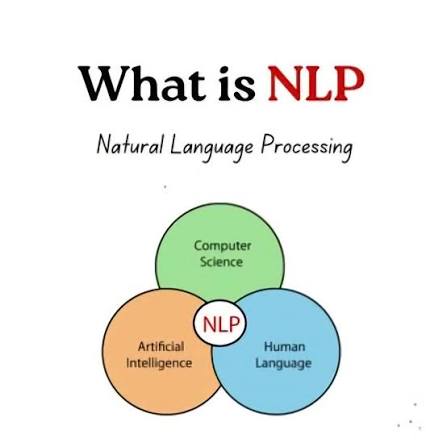
Natural Language Processing (NLP) is a branch of artificial intelligence that enables computers to interpret, understand, and generate human language in text or speech. It combines computational linguistics, machine learning, and deep learning to bridge the gap between human communication and machine understanding.
Why NLP Matters Today
- Explosive Growth: The global NLP market in healthcare and life sciences is projected to grow significantly, driven by unstructured data in electronic health records (EHRs), where up to 80% of clinical data is text-based.
- Healthcare Revolution in India: NLP powers clinical decision support, automates medical transcription in regional languages, analyzes patient feedback, and supports telemedicine. It helps extract insights from diverse sources like Hindi, Tamil, or English notes, addressing India’s linguistic diversity.
- Broader Impact: From chatbots handling patient queries to sentiment analysis on social media for public health trends, NLP is foundational to modern AI.
Key Stats:
- NLP adoption in healthcare can reduce administrative burden by extracting data from notes in seconds.
- In India, rising AI investments in health tech (e.g., AI scribes for doctors) highlight the need for NLP literacy.
How NLP Works:
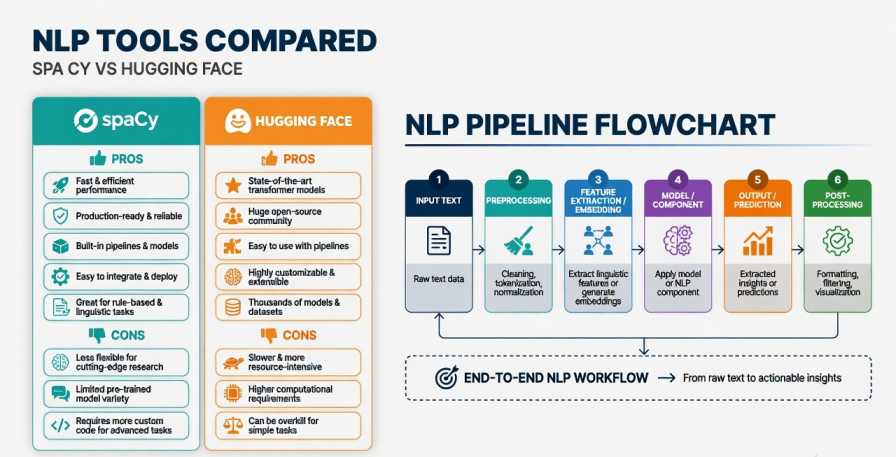
NLP transforms unstructured language into structured data machines can act upon through a pipeline of steps.
Core NLP Pipeline
- Tokenization: Breaking text into words, sentences, or subwords (e.g., “Patient has fever” => [“Patient”, “has”, “fever”]).
- Text Preprocessing: Lowercasing, removing stopwords/punctuation, stemming/lemmatization (reducing “running” to “run”).
- Part-of-Speech Tagging: Identifying nouns, verbs, etc.
- Named Entity Recognition (NER): Detecting entities like names, diseases, medications (“Diabetes” as a condition).
- Parsing and Dependency: Understanding sentence structure and relationships.
- Semantic Analysis: Capturing meaning via word embeddings (vectors representing words like “king” – “man” + “woman” ≈ “queen”).
- Advanced Models: Transformers (e.g., BERT) use attention mechanisms for context.
Key Benefits
- Efficiency: Automates tedious tasks like coding medical records.
- Accuracy: Improves diagnosis by analyzing full patient history.
- Accessibility: Supports multilingual processing for India’s 22+ official languages.
- Personalization: Powers chatbots for patient engagement.
Tools, Comparisons, and Real-World Examples
Popular open-source libraries dominate for beginners and developers.
NLP Tools/Libraries
- NLTK: Great for education and prototyping; rich in corpora but slower for production.
- spaCy: Fast, production-ready with excellent pipelines for NER and dependency parsing.
- Hugging Face Transformers: Hub for pre-trained models like BERT; ideal for transfer learning.
- Google Cloud Natural Language / IBM Watson: Enterprise options with strong cloud integration.
Pros/Cons Table:
| Tool/Library | Pros | Cons | Best For (India Context) |
|---|---|---|---|
| NLTK | Easy learning, free corpora | Slow for large data | Beginners, tutorials |
| spaCy | Speed, accuracy | Steeper initial curve | Clinical text processing |
| Hugging Face | Pre-trained models, community | Compute-intensive | Multilingual Indian healthcare |
| Google Cloud NLP | Scalable, APIs | Cost for heavy use | Telemedicine apps |
Examples:
- Healthcare: NLP extracts symptoms from doctor notes to flag diseases.
- Development: Building a chatbot for appointment booking in Hindi.
Build a Simple NLP Sentiment Analyzer
Here’s a practical, beginner-friendly tutorial using Python and NLTK/spaCy. Assume you have Python installed.
1. Install Required Libraries
pip install nltk spacy scikit-learn pandas
python -m spacy download en_core_web_sm
Method 1: Sentiment Analysis with NLTK (VADER)
import nltk
from nltk.sentiment import SentimentIntensityAnalyzer

# Download VADER lexicon
nltk.download('vader_lexicon')

# Initialize analyzer
sia = SentimentIntensityAnalyzer()

# Sample text
text = "Patient feels much better after treatment."

# Analyze sentiment
sentiment = sia.polarity_scores(text)

print("Text:", text)
print("Sentiment Scores:")
print(sentiment)

# Determine sentiment
if sentiment['compound'] >= 0.05:
    print("Overall Sentiment: Positive")
elif sentiment['compound'] <= -0.05:
    print("Overall Sentiment: Negative")
else:
    print("Overall Sentiment: Neutral")
Sample Output
Text: Patient feels much better after treatment.
Sentiment Scores:
{'neg': 0.0, 'neu': 0.533, 'pos': 0.467, 'compound': 0.6114}

Overall Sentiment: Positive
Method 2: NLP Processing with spaCy
This example extracts entities, tokens, and parts of speech.
import spacy

# Load English model
nlp = spacy.load("en_core_web_sm")

text = "Patient John Smith visited New York Hospital on July 15, 2026."

# Process text
doc = nlp(text)

print("=== Tokens ===")
for token in doc:
    print(token.text, "| POS:", token.pos_)

print("\n=== Named Entities ===")
for ent in doc.ents:
    print(f"{ent.text} --> {ent.label_}")
Sample Output
=== Named Entities ===
John Smith --> PERSON
New York Hospital --> ORG
July 15, 2026 --> DATE
Method 3: Build a Basic Sentiment Classifier Using Scikit-Learn
Training Data
import pandas as pd

data = {
    "text": [
        "I love this product",
        "This is amazing",
        "Excellent service",
        "Very happy with the results",
        "I hate this",
        "Terrible experience",
        "Very disappointed",
        "Worst service ever"
    ],
    "label": [
        "positive",
        "positive",
        "positive",
        "positive",
        "negative",
        "negative",
        "negative",
        "negative"
    ]
}

df = pd.DataFrame(data)

print(df)
Train the Model
from sklearn.model_selection import train_test_split
from sklearn.feature_extraction.text import CountVectorizer
from sklearn.naive_bayes import MultinomialNB
from sklearn.pipeline import Pipeline

# Training data
texts = df["text"]
labels = df["label"]

# Create NLP pipeline
model = Pipeline([
    ("vectorizer", CountVectorizer()),
    ("classifier", MultinomialNB())
])

# Train model
model.fit(texts, labels)

print("Model trained successfully!")
Predict New Sentences
test_sentences = [
    "The treatment worked very well",
    "I am unhappy with the service",
    "The doctor was excellent",
    "This was a horrible experience"
]

predictions = model.predict(test_sentences)

for text, sentiment in zip(test_sentences, predictions):
    print(f"Text: {text}")
    print(f"Predicted Sentiment: {sentiment}")
    print("-" * 40)
Sample Output
Text: The treatment worked very well
Predicted Sentiment: positive

Text: I am unhappy with the service
Predicted Sentiment: negative
Challenges and Solutions
NLP isn’t perfect:
- Ambiguity and Context: Sarcasm or dialects confuse models. Solution: Fine-tune with domain-specific (e.g., Indian medical) data.
- Data Bias and Privacy: Models trained on Western data underperform in India; HIPAA-like compliance needed. Solution: Use federated learning and anonymization.
- Multilingual Complexity: India’s diversity. Solution: IndicBERT or similar.
- Compute Resources: Expensive for large models. Solution: Cloud credits or lighter models.
- Hallucinations in Generative NLP: Solution: Human-in-loop validation.
Future Outlook and My Take
By 2026+, expect efficient transformers, multimodal NLP (text + images for radiology reports), and agentic AI for autonomous clinical assistants. In India, integration with UPI/Aadhaar for seamless health tech is promising.
My Take as Tech Blogger: NLP’s true value lies in augmentation, not replacement freeing doctors for empathy-driven care. Start experimenting today to stay ahead in India’s AI health boom. Focus on ethical, inclusive models tailored to local needs.
Conclusion
NLP basics reveal how machines process human language through tokenization, embeddings, and advanced models, unlocking immense potential in healthcare and beyond. From background fundamentals to practical tutorials and future insights, this guide provides a solid foundation.
Apply these concepts: Try the tutorial, audit your clinic’s data, or build a simple tool. Share your experience in the comments what NLP challenge are you facing? Subscribe for more on AI in healthcare and programming. For collaborations, reach out at contact@vitalstack.co.in.
FAQ’s
1. What is NLP in simple terms?
NLP is AI technology that helps machines read, understand, and respond to human language like doctors’ notes or patient queries.
2. How is NLP used in Indian healthcare?
It analyzes EHRs, supports regional language processing, automates billing/coding, and aids predictive diagnostics under digital health missions.
3. Which tool is best for NLP beginners?
NLTK for learning; transition to spaCy or Hugging Face for real projects.
4. What are the main challenges of NLP?
Ambiguity, bias, data scarcity in low-resource languages, and high computational costs.
5. Do I need advanced math to learn NLP?
Basics suffice to start; libraries handle complexity. Focus on practical application first.
6. How can NLP improve patient outcomes?
By quickly surfacing insights from records, reducing errors, and enabling personalized care.
Read More on VitalStack
- Prompt Engineering Mastery: Better AI Outputs
- How AI Is Transforming Customer Support: Faster Responses, Better Experiences, and Smarter Service
- The Science Behind Dopamine and Motivation: Why Your Brain Loves Progress
- Daily Habits That Improve Brain Productivity: Simple Changes That Made a Big Difference
- Large Language Models Transforming Healthcare: Opportunities and Challenges in 2026
Enjoyed this article?
Subscribe for weekly deep-dives on AI and health — straight to your inbox.