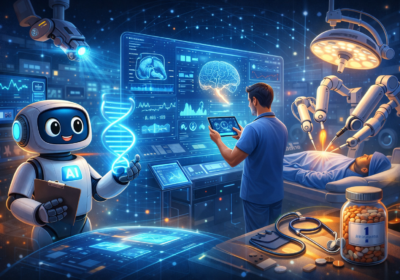

Introduction
A few years ago, most people associated artificial intelligence with chatbots and content generation.
Today, the conversation has expanded significantly.
Healthcare organizations, researchers, hospitals, and technology companies are exploring how large language models can assist with administrative work, medical research, patient communication, and clinical workflows.
During the past year, I followed numerous healthcare AI developments and tested several AI systems for research and information retrieval purposes.
One thing became clear.
The biggest impact of AI in healthcare may not be replacing professionals.
Instead, it may be helping healthcare teams save time, reduce repetitive work, and access information more efficiently.
That distinction is important because healthcare remains a human-centered field where trust, expertise, and professional judgment matter.
What Are Large Language Models?
Large Language Models (LLMs) are AI systems trained on massive amounts of text data.
They can:
- Summarize information
- Generate text
- Answer questions
- Extract key insights
- Assist with research
Popular examples include:
- ChatGPT
- Gemini
- Claude
- Microsoft Copilot
In healthcare environments, these systems are increasingly being adapted to support specialized workflows.
Why Healthcare Is Interested in LLMs
Healthcare professionals spend a significant amount of time on documentation, administrative tasks, and information management.
Many organizations are exploring AI because it can potentially help with:
- Medical note summarization
- Patient communication
- Documentation assistance
- Clinical workflow support
- Research analysis
The goal is not simply automation.
The goal is giving professionals more time to focus on patient care.
Real-World Example: Medical Documentation
One frequently discussed application involves clinical documentation.
Doctors often spend considerable time creating notes after appointments.
AI-powered documentation systems can help organize conversations into structured summaries.
Practical Scenario
Imagine a physician seeing dozens of patients during a busy day.
Instead of manually organizing every note from scratch, an AI system may help generate a draft summary that can be reviewed and edited by the healthcare professional.
This can reduce administrative workload while maintaining human oversight.
AI Systems Already Being Explored in Healthcare
Several organizations are actively developing healthcare-focused AI systems.
ChatGPT
Used for research assistance, drafting educational materials, and workflow support.
Gemini
Being explored for information retrieval, summarization, and productivity tasks.
Microsoft Copilot
Used in enterprise environments to assist with documentation and workflow management.
Healthcare-Specific AI Platforms
Many hospitals and healthcare technology companies are developing customized AI systems designed specifically for clinical environments and regulatory requirements.
My Personal Research Experience
While researching digital health topics, I experimented with LLMs to summarize lengthy healthcare reports and academic articles.
Normally, reviewing a 40-page report can take a substantial amount of time.
Using AI-assisted summaries helped identify key sections more quickly.
However, I always verified important information directly from the original source.
This highlighted an important lesson.
AI can accelerate information processing, but human review remains essential.
Opportunities Created by LLMs
Faster Information Access
Healthcare professionals often work with large amounts of information.
AI can help organize and summarize relevant material.
Improved Administrative Efficiency
Reducing repetitive documentation tasks may free up time for patient-focused activities.
Enhanced Patient Communication
AI systems can help create easier-to-understand educational content and support materials.
Research Support
Researchers can use AI tools to identify relevant studies and summarize complex information more efficiently.
Challenges and Risks
While the opportunities are exciting, significant challenges remain.
Accuracy Concerns
Large language models can sometimes generate incorrect or misleading information.
In healthcare environments, accuracy is critical.
Privacy and Security
Healthcare information is highly sensitive.
Organizations must ensure patient data is protected and handled appropriately.
Regulatory Compliance
Healthcare systems operate under strict regulations that AI solutions must follow.
Human Oversight
AI-generated outputs should always be reviewed by qualified professionals before being used in clinical decision-making.
Real-Life Test Case: Information Verification
During one research session, I asked multiple AI systems to summarize a healthcare technology report.
The summaries were useful for understanding key themes.
However, some details varied slightly between systems.
This reinforced the importance of verifying critical information directly from trusted sources.
AI accelerated the process.
It did not replace fact-checking.
What Healthcare Professionals Think
Many healthcare professionals see AI as a supportive tool rather than a replacement.
The most promising use cases often involve:
- Reducing paperwork
- Streamlining documentation
- Improving workflow efficiency
- Supporting research activities
These applications allow professionals to focus more on patient interactions and complex decision-making.
The Future of LLMs in Healthcare
The next few years will likely bring:
- More specialized healthcare AI models
- Better integration with clinical systems
- Improved safety mechanisms
- Enhanced regulatory oversight
- More personalized patient experiences
The future is unlikely to be fully automated healthcare.
Instead, it will probably involve collaboration between human expertise and AI assistance.
Important Reality Check
Large language models are powerful tools, but they are not doctors.
They cannot replace medical training, professional judgment, or personalized healthcare advice.
The safest and most effective approach is using AI as an assistant while keeping qualified healthcare professionals at the center of care decisions.
Final Thoughts
Healthcare is one of the most promising areas for AI innovation.
Large language models have the potential to improve efficiency, support research, and reduce administrative burdens.
At the same time, challenges involving accuracy, privacy, and oversight require careful attention.
The organizations that succeed will likely be those that combine the speed of AI with the expertise and empathy of human professionals.
Conclusion
Large language models are transforming healthcare in 2026 by helping organizations improve workflows, streamline documentation, support research, and enhance communication.
While significant challenges remain, the technology continues to evolve rapidly.
The future of healthcare will not be defined by AI alone, but by how effectively humans and AI work together to improve outcomes and experiences.
FAQ’s
What are large language models in healthcare?
Large language models are AI systems that can analyze and generate text to assist with healthcare-related tasks such as documentation, research, and communication.
Can AI replace doctors?
No. AI can assist healthcare professionals, but it cannot replace medical expertise, clinical judgment, or patient care.
How are hospitals using AI today?
Many hospitals are exploring AI for documentation support, workflow optimization, information retrieval, and administrative efficiency.
What are the risks of healthcare AI?
Potential risks include inaccurate outputs, privacy concerns, security issues, and overreliance on AI-generated information.
What is the future of AI in healthcare?
Future developments may include more specialized healthcare models, improved integrations, and stronger safety and compliance measures.
Read More on VitalStack
- How Screen Time Affects Mental Performance: What I Learned From Tracking My Daily Habits
- At-Home Health Testing and AI Analysis: Trends Shaping Everyday Wellness
- AI for Personalized Nutrition and Fitness: Tailoring Plans to Your Unique Needs
- How AI Makes Remote Patient Monitoring More Effective and Accessible in 2026
- Top Wearable Devices for Personalized Health Monitoring in the AI Era
Enjoyed this article?
Subscribe for weekly deep-dives on AI and health — straight to your inbox.