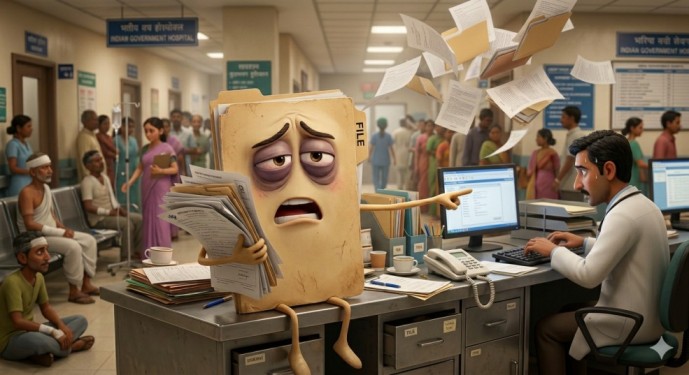
If you have ever visited a busy Indian hospital, you probably already know how stressful the environment can feel.
Long waiting lines.
Doctors rushing between patients.
Reception staff handling endless paperwork.
Patients asking the same questions repeatedly.
Phones constantly ringing.
And honestly, many doctors today are not only tired from treating patients they are also mentally exhausted from handling administrative work every single day.
In many hospitals across India, doctors spend hours doing things like:
- Updating patient records
- Writing discharge summaries
- Managing prescriptions
- Scheduling follow-ups
- Reviewing reports
- Handling insurance documentation
Sometimes, this paperwork takes almost as much energy as actual patient care.
And this is exactly why healthcare AI is getting so much attention in 2026.
Not because hospitals want robots replacing doctors.
But because doctors genuinely need help managing repetitive digital work.
The Reality Inside Many Indian Hospitals
A few months ago, I visited a private hospital with one of my relatives for a routine health checkup.
What surprised me most was not the treatment process.
It was the amount of coordination happening behind the scenes.
One doctor was treating patients while simultaneously:
- Checking reports on a computer
- Updating patient history
- Calling another department
- Reviewing prescriptions
- Responding to hospital staff questions
Honestly, it looked exhausting.
And this is not just one hospital.
Many Indian healthcare workers deal with this pressure daily.
Especially in larger cities like:
- Ahmedabad
- Mumbai
- Delhi
- Bangalore
- Hyderabad
where patient volume is extremely high.
So What Exactly Are AI Agents?
In simple words, AI agents are digital systems designed to handle repetitive tasks automatically.
Unlike a normal chatbot that only answers questions, AI agents can actually help organize workflows.
For example, they may:
- Send appointment reminders
- Organize patient schedules
- Track follow-ups
- Generate summaries
- Help manage records
- Alert staff about missed appointments
Think of them like digital assistants quietly helping hospital teams in the background.
And honestly, this feels much more practical than the “AI replacing doctors” headlines people often see online.
A Real-Life Example Many Indian Clinics Can Relate To
Let’s imagine a clinic in Gujarat handling around 250 patients daily.
Normally, staff members may spend hours:
- Calling patients manually
- Confirming appointments
- Updating records
- Managing queues
- Checking follow-up schedules
Now imagine an AI system handling some of those repetitive tasks automatically.
For example:
- Patients receive automatic reminder messages
- Follow-up appointments get scheduled digitally
- Reports become easier to organize
- Staff receive alerts for delayed appointments
Doctors still supervise everything.
But suddenly, hospital staff save valuable time every day.
Honestly, even reducing 1–2 hours of repetitive work daily can make a huge difference in overloaded healthcare systems.
One Small Test Case That Makes Sense
A diabetic patient usually requires:
- Regular follow-ups
- Medicine reminders
- Blood sugar tracking
- Test scheduling
But in reality, many patients forget appointments or delay checkups.
Now imagine an AI system that:
- Sends reminders automatically
- Alerts staff if appointments are missed
- Tracks patient history
- Organizes prescription timelines
This may sound simple.
But honestly, these small workflow improvements can help hospitals stay far more organized.
And for patients, it reduces confusion too.
AI Is Not Replacing Doctors
This is something important many people misunderstand.
AI agents are not replacing medical expertise.
They are mainly helping reduce repetitive coordination work.
Because healthcare still needs:
- Human decision-making
- Emotional understanding
- Experience
- Trust between doctors and patients
No AI system can fully replace that.
And honestly, most doctors themselves are not asking for replacement.
They simply want less administrative overload.
Why This Matters More in India
India’s healthcare system handles an enormous number of patients every day.
Many hospitals already struggle with:
- Staff shortages
- Limited time
- Long waiting lines
- Manual systems
- Administrative pressure
In smaller clinics, one person often handles multiple responsibilities simultaneously.
That’s why workflow automation is becoming increasingly important.
Not as a luxury.
But as a practical support system.
The Good Side of Healthcare AI
If implemented properly, AI agents could help hospitals:
- Reduce repetitive work
- Improve patient coordination
- Organize records faster
- Reduce missed follow-ups
- Improve workflow efficiency
And honestly, many healthcare workers would probably welcome any system that saves time without increasing stress.
Because burnout in healthcare is becoming very real now.
But There Are Still Concerns
Of course, healthcare AI also raises valid concerns.
Hospitals still worry about:
- Patient privacy
- Data security
- System reliability
- Language support
- AI mistakes
- Technology costs
And honestly, these concerns should not be ignored.
Healthcare is sensitive.
Even small mistakes can create serious problems.
That’s why AI systems still require proper supervision and responsible implementation.
My Honest Observation About Healthcare Technology
Personally, I think the most useful healthcare AI systems are not the flashy futuristic robots.
The real value comes from simple tools that:
- Save doctors time
- Reduce stress
- Improve coordination
- Make hospitals more organized
Because sometimes better healthcare is not about complicated technology.
Sometimes it’s simply about helping doctors spend more time with patients instead of screens.
And honestly, many Indian hospitals could genuinely benefit from that kind of support.
Final Thoughts
AI agents are slowly becoming practical healthcare tools in India.
Not because they replace doctors.
But because they help reduce repetitive administrative pressure that already overwhelms many healthcare workers daily.
The future of healthcare AI in India will probably depend on balance:
- Using technology responsibly
- Keeping humans involved
- Improving workflows without removing human care
And honestly, if used carefully, AI agents may become one of the most helpful healthcare support tools Indian hospitals have seen in years.
FAQ 1
What are AI agents in healthcare?
AI agents are systems designed to automate repetitive healthcare tasks like scheduling, reminders, documentation, and workflow coordination.
FAQ 2
Can AI reduce workload for Indian doctors?
AI systems may help reduce repetitive administrative work and improve workflow efficiency in hospitals and clinics.
FAQ 3
Will AI replace doctors in India?
No, healthcare still requires human expertise, emotional understanding, and medical judgment that AI cannot fully replace.
FAQ 4
Why are hospitals using healthcare AI?
Hospitals are exploring AI tools to improve organization, reduce workload, and manage patient coordination more efficiently.
FAQ 5
Is healthcare AI safe?
Healthcare AI still requires proper supervision, security, and responsible implementation to avoid errors and protect patient data.
Read More on VitalStack
- How Agentic AI Agents Can Actually Reduce Doctor Burnout in 2026
- What is Agentic AI? A Simple Explanation for Doctors and Everyday People
- Spotify’s Massive AI Expansion Is Changing the App Faster Than Ever
- AI Breakthrough in Age Reversal: Can Technology Extend Human Life in 2026?
- Google’s New Gmail AI Lets You Talk to Your Inbox Instead of Searching Emails
Enjoyed this article?
Subscribe for weekly deep-dives on AI and health — straight to your inbox.