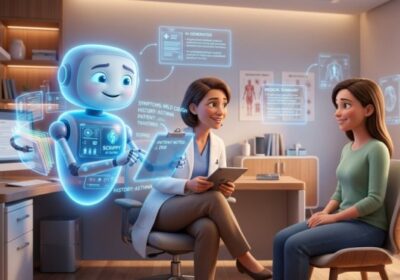

Healthcare is entering a very different phase of artificial intelligence adoption.
For years, most conversations around AI in medicine focused on diagnostics, data analysis, or futuristic robot-doctor ideas. But in 2026, the industry is starting to pay attention to something more practical and potentially more useful in everyday healthcare environments:
Unlike traditional AI systems that mainly respond to commands, agentic AI systems are designed to assist more proactively. These systems can monitor workflows, analyze information, recommend actions, and help healthcare professionals manage tasks more efficiently.
In simple terms, AI is slowly evolving from being just a software tool into something closer to a digital teammate.
And honestly, that shift is becoming increasingly visible across hospitals, healthcare startups, and digital health platforms.
If you’ve visited a hospital recently, you’ve probably noticed how much time doctors spend looking at screens instead of talking directly with patients. A large part of modern healthcare now involves managing digital systems, reports, and documentation.
That’s one reason AI tools are getting so much attention in the medical industry right now.
What Is Agentic AI?
Agentic AI refers to artificial intelligence systems capable of performing tasks more independently to help achieve specific goals.
Instead of waiting for step-by-step instructions every time, these systems can:
- Observe situations
- Analyze patterns
- Recommend actions
- Automate repetitive work
- Coordinate workflows
In healthcare, this could mean helping doctors and medical teams manage the overwhelming amount of information they deal with daily.
For example, an AI system may:
- Monitor patient records
- Flag unusual symptoms or health trends
- Suggest follow-up actions
- Organize clinical notes
- Help coordinate scheduling
The important thing to understand is that agentic AI is not being built to replace doctors.
At least right now, the real focus is on reducing administrative overload and improving efficiency behind the scenes.
Why Healthcare Is Interested in Agentic AI
Modern healthcare systems generate massive amounts of data every single day.
Doctors often juggle:
- Electronic health records
- Lab reports
- Imaging results
- Prescriptions
- Appointment scheduling
- Insurance documentation
And one growing issue in healthcare is that many professionals spend enormous amounts of time handling administrative work instead of directly interacting with patients.
Some healthcare professionals have openly said that administrative work has become one of the most exhausting parts of the job.
In many hospitals, doctors spend hours updating records, organizing reports, and handling repetitive digital tasks after patient appointments. Even small workflow improvements can make a noticeable difference in reducing stress and saving time.
That’s one reason AI is attracting so much attention in the healthcare industry.
Many hospitals and healthcare companies are now exploring AI systems that can reduce repetitive tasks and help medical staff focus more on patient care.
And honestly, burnout among healthcare professionals has become such a serious issue that even small workflow improvements are being taken very seriously.
Real-World Examples of Agentic AI in Healthcare
Fully autonomous healthcare AI may still be years away, but practical AI assistants are already starting to appear in real medical environments.
AI Clinical Assistants
Some healthcare organizations are testing AI assistants that can summarize doctor-patient conversations and automatically generate medical notes.
This may sound simple, but documentation takes up a huge amount of time in modern healthcare.
Reducing that workload could help doctors spend more time focusing on patients instead of screens.
Imagine a doctor finishing an appointment and having AI automatically organize the discussion into structured medical notes within seconds.
That kind of support may sound small at first, but across dozens of patient visits every day, it could save healthcare teams significant time.
Predictive Patient Monitoring
AI systems can also continuously analyze patient data and alert healthcare teams if unusual patterns appear.
For example:
- Abnormal heart activity
- Medication conflicts
- Sudden changes in vital signs
In some cases, faster alerts could improve response times during critical situations.
For example, if a patient’s heart activity suddenly changes during monitoring, an AI system could quickly alert medical staff before the situation becomes more serious.
In healthcare, even a few minutes can sometimes matter enormously.
Smarter Hospital Workflows
Hospitals are also experimenting with AI systems that help coordinate:
- Patient scheduling
- Resource allocation
- Follow-up reminders
- Test prioritization
Healthcare systems are extremely complex environments, and even small operational improvements can make a significant difference.
Why Agentic AI Matters in 2026
Healthcare systems around the world are facing increasing pressure.
Some major challenges include:
- Rising healthcare costs
- Staff shortages
- Aging populations
- Administrative overload
- Growing patient demand
AI is increasingly being viewed as one possible way to help healthcare systems operate more efficiently without reducing quality of care.
One interesting thing about the healthcare AI conversation in 2026 is that the industry is becoming more realistic.
A few years ago, discussions often focused on AI replacing doctors entirely.
Now, many experts believe the most useful AI systems will probably be the ones quietly supporting medical professionals rather than trying to replace human decision-making altogether.
That’s a very important shift.
One thing that’s becoming increasingly clear in 2026 is that healthcare AI conversations are becoming more practical and less science-fiction focused.
Instead of asking whether AI will replace doctors tomorrow, many hospitals are now asking a simpler question:
How can AI help medical professionals work more efficiently today?
Challenges and Concerns Still Exist
Despite the excitement around healthcare AI, there are still serious concerns that cannot be ignored.
Data Privacy
Healthcare data is highly sensitive.
AI systems handling patient information must follow strict privacy and security standards.
Concerns around:
- Data protection
- Cybersecurity
- Patient consent
- Information misuse
are becoming increasingly important as AI systems become more connected to healthcare workflows.
Accuracy Still Matters
Medical decisions require extremely high accuracy.
Even advanced AI systems can make mistakes or produce unreliable recommendations.
That’s why most experts agree AI should assist healthcare professionals rather than operate independently without human oversight.
Human judgment still matters enormously in medicine.
Ethical Questions
As AI becomes more involved in healthcare, ethical questions are growing too.
For example:
- Who is responsible if AI makes a wrong recommendation?
- How transparent should healthcare AI systems be?
- Can AI systems avoid bias in medical decision-making?
These are discussions regulators, hospitals, and technology companies will likely continue debating for years.
Future Trends in Healthcare AI
Agentic AI is still evolving, but the technology is advancing quickly.
Some future trends may include:
- Personalized healthcare assistants
- AI-powered remote monitoring
- Smarter hospital management systems
- AI-assisted medical research
- Real-time treatment optimization
Some experts believe future AI systems may eventually work almost like digital support staff for healthcare professionals.
However, human doctors will likely remain central to patient care for a long time.
Trust, empathy, communication, and clinical judgment are still deeply human skills that technology cannot easily replicate.
Final Thoughts
Agentic AI is becoming one of the most interesting developments in modern healthcare technology.
Instead of replacing doctors, these systems are increasingly being designed to reduce administrative pressure, improve efficiency, and support healthcare workflows behind the scenes.
While concerns around privacy, ethics, and accuracy remain important, many healthcare organizations now see AI as a practical support tool rather than just futuristic experimentation.
And honestly, that may be where healthcare AI creates the biggest real-world impact over the next decade.
The future of medicine may not look like robots taking over hospitals.
It may look more like intelligent systems quietly helping doctors make faster, better-informed decisions every day.
Technology alone cannot replace human care, empathy, or medical experience.
But if AI can reduce paperwork, improve efficiency, and help doctors focus more on patients, that alone could become one of the most important healthcare shifts of this decade.
🔗 Related Articles
Enjoyed this article?
Subscribe for weekly deep-dives on AI and health — straight to your inbox.