

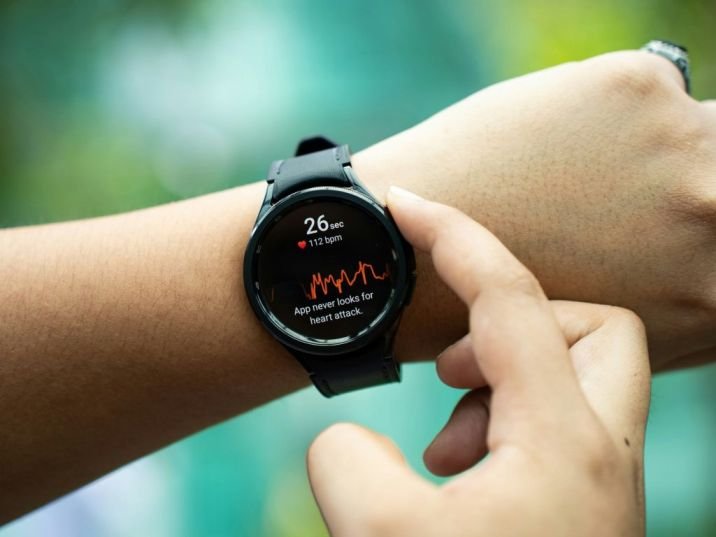
Samsung researchers have developed two AI foundation models designed to analyze health signals collected from wearable devices such as smartwatches.
The research focuses on biosignals including heart activity, sleep and physical movement. Samsung says the technology could eventually help make wearable health insights more personalized and continuous.
The research was presented as part of Samsung’s broader Connected Care vision, which focuses on using technology to support more connected and personalized health experiences.
Two AI Models for Wearable Health Data
Samsung Research America developed two models called xMAE and HiMAE.
The models are designed to learn patterns from large amounts of wearable data without requiring every piece of information to be manually labeled.
xMAE focuses on relationships between different cardiac signals, while HiMAE analyzes wearable data across different time periods.
This allows the models to study both fast-changing signals, such as heart activity, and longer patterns related to areas such as sleep and physical activity.
xMAE Connects PPG and ECG Signals
One of the key areas of Samsung’s research is the relationship between photoplethysmography (PPG) and electrocardiogram (ECG) signals.
ECG measures the electrical activity of the heart, while PPG uses changes in blood flow to capture information through optical sensors commonly found in smartwatches.
Samsung’s xMAE model was trained to understand the relationship between these signals. The company says it used around 9,400 hours of ECG and PPG data during pretraining.
In Samsung’s testing, xMAE outperformed several existing approaches across 15 of 19 evaluation tasks, including cardiovascular prediction, abnormal test-result detection and sleep-stage classification.
HiMAE Looks at Health Patterns Over Time
The second model, HiMAE, is designed to analyze wearable data at multiple time scales.
Short periods of data can provide information about rapidly changing signals, while longer periods can reveal patterns related to sleep and physical activity.
Samsung says HiMAE can support several types of tasks, including classification, numerical prediction and data generation.
The company also reports that the model can run in less than one millisecond on a smartwatch-class CPU under its tested conditions.
Focus on On-Device AI
One of the most interesting aspects of Samsung’s research is its focus on running AI models directly on wearable hardware.
On-device processing could reduce the need to continuously send health data to cloud servers. It could also make some health-related AI features faster and potentially more useful when a device has limited connectivity.
However, the research models are not the same as a consumer medical diagnostic system. More validation would be needed before technologies like these could be used for clinical decision-making.
Read More on VitalStack
Enjoyed this article?
Subscribe for weekly deep-dives on AI and health — straight to your inbox.